


Page 107 - JSOM Spring 2018
P. 107
Fitness (TFF) frameworks were developed to instruct the ways   FIGURE 1  A depiction of vertical and horizontal spirituality.
              in which overall fitness should be identified, understood, and
              assessed across unique domains.

              Spirituality is a key interweaving and interacting domain, and
              an integral component for maintaining SOF readiness. To date,
              however, spirituality remains an under-researched area and
              likely one of the most poorly understood domains of POTFF/
              TFF. This article explains the importance of spirituality as a
              component of SOF performance and describes approaches to
              enhancing performance through various spiritual activities.

              Spiritual Fitness and Spiritual Performance Defined
              The conventional definition of religion and spirituality posits
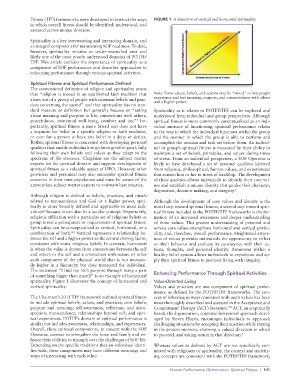
              that “religion is rooted in an established faith tradition that   Note: Some values, beliefs, and actions may be “mixed” in that people
              arises out of a group of people with common beliefs and prac-  experience and feel meaning, purpose, and connectedness with others
              tices concerning the sacred” and that spirituality has no stan-  and a higher power.
              dard measure or definition but generally focuses on “asking   Spirituality as it relates to POTFF/TFF can be explored and
              about meaning and purpose in life, connections with others,   understood from individual and group perspectives. Although
              peacefulness,  existential well-being, comfort and joy.”  Im-  spiritual fitness is more commonly conceptualized as an indi-
                                                         5
              portantly, spiritual fitness is more broad and does not have   vidual measure of functioning, spiritual performance relates
              a requisite for belief in a specific religion or faith tradition,   to the way in which the individual functions within the group
              or even for a person to have any belief in a deity or deities.   and the manner in which the group is able to perform and
              Rather, spiritual fitness is concerned with developing personal   accomplish the mission and task set before them. An individ-
              qualities that enable individuals to go from good to great, fully   ual or group’s spiritual fitness is measured by their ability to
              following their own beliefs and values as they adapt to the   maintain a set of beliefs, principles, and values during times
              spectrum of life stressors.  Chaplains are the subject matter   of stress. From an individual perspective, a SOF Operator is
              experts for the spiritual domain and support development of   likely to have developed a set of personal qualities (derived
              spiritual fitness as a valuable aspect of HPO. However, other   from religious, philosophical, human values, and experiences)
              providers and personnel may also encounter spiritual fitness   that sustain him or her in times of hardship. The development
              concerns in their own population and must be aware of the   of these qualities allows individuals to identify their core val-
              appropriate subject matter experts to maintain best practice.  ues and establish a unique identity that guides their character,
                                                                 disposition, decision-making, and integrity. 6
              Although religion is defined as beliefs, practices, and rituals
              related to transcendence and God or a higher power, spiri-  Although the development of core values and identity is the
              tualty is more broadly defined and applicable to most indi-  initial step toward spiritual fitness, a second step toward spiri-
              viduals  because it can also be a secular concept. Importantly,   tual fitness included in the POTFF/TFF frameworks is the for-
                   6
              religious affiliation with a particular set of religious beliefs or   mation of an increased awareness and deeper understanding
              group is not a prerequisite or requirement of spiritual fitness.   of those values. This greater understanding of personal and
              Spirituality can be conceptualized as vertical, horizontal, or a   service core values strengthens horizontal and vertical spiritu-
              combination of both.  Vertical represents a relationship be-  ality, and, therefore, overall performance. Heightened aware-
                              4,5
              tween the self and a higher power as the central driving factor,   ness of values provides individuals the opportunity to reflect
              consistent with many religious beliefs. In contrast, horizontal   on their behavior and evaluate its consistency with their ac-
              is when the value is drawn from connections between the self   tions, thoughts, and personal identity. Awareness within a
              and others or the self and a connection with nature or other   healthy belief system allows individuals to experience and ap-
              such component of the physical world that is not necessar-  ply their spiritual fitness to promote living with integrity.
              ily higher in a hierarchy but does transcend the individual.
              The statement “I find my life’s purpose through being a part
              of something bigger than myself” is an example of horizontal   Enhancing Performance Through Spiritual Activities
              spirituality. Figure 1 illustrates the concept of horizontal and   Value-Directed Living
              vertical spirituality.                             Values and practices are one component of spiritual perfor-
                                                                 mance as defined by the POTFF/TFF frameworks. The con-
              The Chairman’s 2011 TFF framework outlined spiritual fitness   cept of behaving in ways consistent with one’s values has been
              to include spiritual beliefs, values, and practices; core beliefs;   most thoroughly described and assessed in the Acceptance and
              purpose and meaning; self-awareness, reflection, and intro-  Commitment Therapy (ACT) literature.  ACT, an empirically
                                                                                               7,8
              spection; transcendence; relationships beyond self; and spiri-  based, third-generation, cognitive-behavioral approach devel-
              tual experiences. POTFF’s domain of spiritual performance is   oped by Steven Hayes, encourages individuals to approach
              similar but includes awareness, relationships, and experiences.   challenging situations by accepting their reaction while staying
              Overall, these spiritual components, in concert with the SOF   in the present moment, choosing a valued direction in which
              Operator, connect to strengthen the force and family and en-  to proceed, and taking action in that direction. 9
              hance their abilities to triumph over the challenges of SOF life.
              Depending on the specific traditions that an individual identi-  Whereas values as defined by ACT are not specifically con-
              fies with, these components may have different meanings and   nected with religiosity or spirituality, the context and underly-
              ways of interacting with each other.               ing concepts are consistent with the POTFF/TFF framework,

                                                                       Human Performance Optimization: Spiritual Fitness  |  101

