


Page 99 - Journal of Special Operations Medicine - Fall 2017
P. 99
Humanitarian Struggle in Burma’s Conflict Zones


                                                           Moe Gyo


              ABSTRACT
              The Back  Pack Health Worker  Team  (BPHWT), a commu-  and preventative primary health care to ethnic people in ar-
              nity-based health organization, provides primary health care   eas in Burma under the control of the EAOs. Moreover, the
              to ethnic people in conflict, remote, and internally displaced   people of the BPHWT, either themselves, their families, and/or
              areas, in Burma (aka Myanmar), controlled by ethnic armed   their  villages, have been subject to the adverse consequences
              organizations fighting against the Burma government. Its   of actions by the Burma military. Humanitarian struggle is
              services include both curative and preventative health care   their way to fight back. This “humanitarian struggle” by the
              through a network of 1,425 health personnel including com-  BPHWT combines the delivery of health care with a political
              munity health workers and village-embedded traditional birth   overlay.
              attendants and village health workers. The BPHWT organiza-
              tional and program model may prove useful to Special Opera-
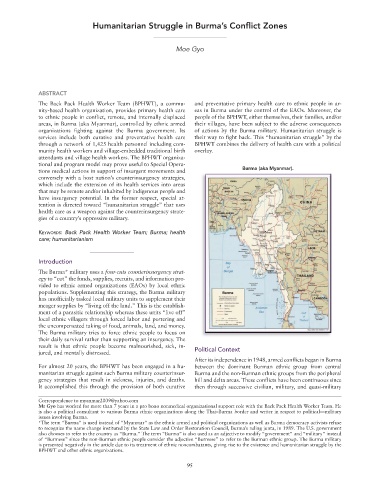
              tions medical actions in support of insurgent movements and       Burma (aka Myanmar).
              conversely with a host nation’s counterinsurgency strategies,
              which include the extension of its health services into areas
              that may be remote and/or inhabited by indigenous people and
              have insurgency potential. In the former respect, special at-
              tention is directed toward “humanitarian struggle” that uses
              health care as a weapon against the counterinsurgency strate-
              gies of a country’s oppressive military.

              Keywords: Back Pack Health Worker Team; Burma; health
              care; humanitarianism


              Introduction
              The Burma* military uses a four-cuts counterinsurgency strat-
              egy to “cut” the funds, supplies, recruits, and information pro-
              vided to ethnic armed organizations (EAOs) by local ethnic
              populations. Supplementing this strategy, the Burma military
              has unofficially tasked local military units to supplement their
              meager supplies by “living off the land.” This is the establish-
              ment of a parasitic relationship whereas these units “live off”
              local ethnic villagers through forced labor and portering and
              the uncompensated taking of food, animals, land, and money.
              The Burma military tries to force ethnic people to focus on
              their daily survival rather than supporting an insurgency. The
              result is that ethnic people become malnourished, sick, in-  Political Context
              jured, and mentally distressed.
                                                                 After its independence in 1948, armed conflicts began in Burma
              For almost 20 years, the BPHWT has been engaged in a hu-  between the dominant Burman ethnic group from central
              manitarian struggle against such Burma military counterinsur-  Burma and the non-Burman ethnic groups from the peripheral
              gency strategies that result in sickness, injuries, and deaths.   hill and delta areas. These conflicts have been continuous since
              It accomplished this through the provision of both curative   then through successive civilian, military, and quasi-military

              Correspondence to myanmar2009@yahoo.com
              Mr Gyo has worked for more than 7 years in a pro bono nonmedical organizational support role with the Back Pack Health Worker Team. He
              is also a political consultant to various Burma ethnic organizations along the Thai–Burma border and writer in respect to political—military
              issues involving Burma.
              *The term “Burma” is used instead of “Myanmar” as the ethnic armed and political organizations as well as Burma democracy activists refuse
              to recognize the name change instituted by the State Law and Order Restoration Council, Burma’s ruling junta, in 1989. The U.S. government
              also chooses to refer to the country as “Burma.” The term “Burma” is also used as an adjective to modify “government” and “military” instead
              of “Burmese” since the non-Burman ethnic people consider the adjective “Burmese” to refer to the Burman ethnic group. The Burma military
              is presented negatively in the article due to its treatment of ethnic noncombatants, giving rise to the existence and humanitarian struggle by the
              BPHWT and other ethnic organizations.

                                                              95

