


Page 101 - Journal of Special Operations Medicine - Fall 2017
P. 101
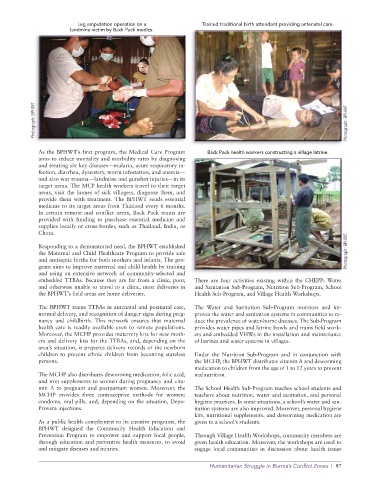
Leg amputation operation on a            Trained traditional birth attendant providing antenatal care.
                        landmine victim by Back Pack medics.


            Photograph: BPHWT                                                                                     Photograph: BPHWT


              As the BPHWT’s first program, the Medical Care Program   Back Pack health workers constructing a village latrine.
              aims to reduce mortality and morbidity rates by diagnosing
              and treating six key diseases—malaria, acute respiratory in-
              fection, diarrhea, dysentery, worm infestation, and anemia—
              and also war trauma—landmine and gunshot injuries—in its
              target areas. The MCP health workers travel to their target
              areas, visit the homes of sick villagers, diagnose them, and
              provide them  with  treatment. The  BPHWT sends essential
              medicine to its target areas from Thailand every 6 months.
              In certain remote and conflict areas, Back Pack teams are
              provided with funding  to purchase essential  medicine and
              supplies locally or cross-border, such as Thailand, India, or
              China.

              Responding to a demonstrated need, the BPHWT established
              the Maternal and Child Healthcare Program to provide safe                                           Photograph: BPHWT
              and antiseptic births for both mothers and infants. The pro-
              gram aims to improve maternal and child health by training
              and using an extensive network of community-selected and
              embedded TTBAs. Because they are far from a clinic, poor,   There are four activities existing within the CHEPP: Water
              and otherwise unable to travel to a clinic, most deliveries in   and Sanitation Sub-Program, Nutrition Sub-Program, School
              the BPHWT’s field areas are home deliveries.       Health Sub-Program, and Village Health Workshops.

              The BPHWT trains TTBAs in antenatal and postnatal care,   The Water and Sanitation Sub-Program  monitors and im-
              normal delivery, and recognition of danger signs during preg-  proves the water and sanitation systems in communities to re-
              nancy and childbirth. This network ensures that maternal   duce the prevalence of water-borne diseases. The Sub-Program
              health care is readily available even to remote populations.   provides water pipes and latrine bowls and trains field work-
              Moreover, the MCHP provides maternity kits for new moth-  ers and embedded VHWs in the installation and maintenance
              ers and delivery kits for the TTBAs, and, depending on the   of latrines and water systems in villages.
              area’s situation, it prepares delivery records of the newborn
              children to prevent ethnic children from becoming stateless   Under the Nutrition Sub-Program and in conjunction with
              persons.                                           the MCHP, the BPHWT distributes vitamin A and deworming
                                                                 medication to children from the age of 1 to 12 years to prevent
              The MCHP also distributes deworming medication, folic acid,   malnutrition.
              and iron supplements to women during pregnancy and vita-
              min A to pregnant and postpartum women. Moreover, the   The School Health Sub-Program teaches school students and
              MCHP provides three contraceptive methods for women:   teachers about nutrition, water and sanitation, and personal
              condoms, oral pills, and, depending on the situation, Depo-  hygiene practices. In some situations, a school’s water and san-
              Provera injections.                                itation systems are also improved. Moreover, personal hygiene
                                                                 kits, nutritional supplements, and deworming medication are
              As a public health complement to its curative programs, the   given to a school’s students.
              BPHWT designed the Community Health Education and
              Prevention Program to empower and support local people,   Through Village Health Workshops, community members are
              through education and preventive health measures, to avoid   given health education. Moreover, the workshops are used to
              and mitigate diseases and injuries.                engage local communities in discussion about health issues

                                                                      Humanitarian Struggle in Burma’s Conflict Zones  |  97

