


Page 103 - Journal of Special Operations Medicine - Fall 2017
P. 103
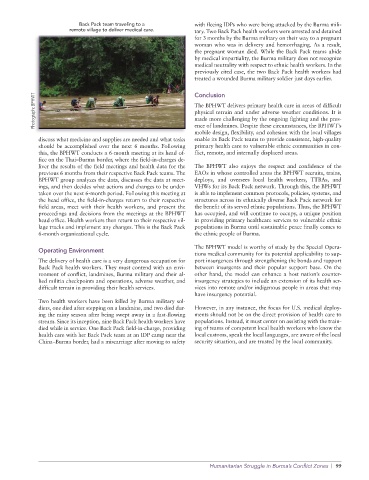
Back Pack team traveling to a         with fleeing IDPs who were being attacked by the Burma mili-
                        remote village to deliver medical care.  tary. Two Back Pack health workers were arrested and detained
                                                                 for 3 months by the Burma military on their way to a pregnant
                                                                 woman who was in delivery and hemorrhaging. As a result,
                                                                 the pregnant woman died. While the Back Pack teams abide
                                                                 by medical impartiality, the Burma military does not recognize
                                                                 medical neutrality with respect to ethnic health workers. In the
                                                                 previously cited case, the two Back Pack health workers had
                                                                 treated a wounded Burma military soldier just days earlier.


                                                                 Conclusion
            Photograph: BPHWT                                    The BPHWT delivers primary health care in areas of difficult
                                                                 physical terrain and under adverse weather conditions. It is
                                                                 made more challenging by the ongoing fighting and the pres-
                                                                 ence of landmines. Despite these circumstances, the BPHWT’s
                                                                 mobile design, flexibility, and cohesion with the local villages
              discuss what medicine and supplies are needed and what tasks   enable its Back Pack teams to provide consistent, high-quality
              should be accomplished over the next 6 months. Following   primary health care to vulnerable ethnic communities in con-
              this, the BPHWT conducts a 6-month meeting at its head of-  flict, remote, and internally displaced areas.
              fice on the Thai–Burma border, where the field-in-charges de-
              liver the results of the field meetings and health data for the   The BPHWT also enjoys the respect and confidence of the
              previous 6 months from their respective Back Pack teams. The   EAOs in whose controlled areas the BPHWT recruits, trains,
              BPHWT group analyzes the data, discusses the data at meet-  deploys,  and oversees  local health  workers,  TTBAs,  and
              ings, and then decides what actions and changes to be under-  VHWs for its Back Pack network. Through this, the BPHWT
              taken over the next 6-month period. Following this meeting at   is able to implement common protocols, policies, systems, and
              the head office, the field-in-charges return to their respective   structures across its ethnically diverse Back Pack network for
              field areas, meet with their health workers, and present the   the benefit of its served ethnic populations. Thus, the BPHWT
              proceedings and decisions from the meetings at the BPHWT   has occupied, and will continue to occupy, a unique position
              head office. Health workers then return to their respective vil-  in providing primary healthcare services to vulnerable ethnic
              lage tracks and implement any changes. This is the Back Pack   populations in Burma until sustainable peace finally comes to
              6-month organizational cycle.                      the ethnic people of Burma.

                                                                 The BPHWT model is worthy of study by the Special Opera-
              Operating Environment
                                                                 tions medical community for its potential applicability to sup-
              The delivery of health care is a very dangerous occupation for   port insurgences through strengthening the bonds and rapport
              Back Pack health workers. They must contend with an envi-  between insurgents and their popular support base. On the
              ronment of conflict, landmines, Burma military and their al-  other hand, the model can enhance a host nation’s counter-
              lied militia checkpoints and operations, adverse weather, and   insurgency strategies to include an extension of its health ser-
              difficult terrain in providing their health services.  vices into remote and/or indigenous people in areas that may
                                                                 have insurgency potential.
              Two health workers have been killed by Burma military sol-
              diers, one died after stepping on a landmine, and two died dur-  However, in any instance, the focus for U.S. medical deploy-
              ing the rainy season after being swept away in a fast-flowing   ments should not be on the direct provision of health care to
              stream. Since its inception, nine Back Pack health workers have   populations. Instead, it must center on assisting with the train-
              died while in service. One Back Pack field-in-charge, providing   ing of teams of competent local health workers who know the
              health care with her Back Pack team at an IDP camp near the   local customs, speak the local languages, are aware of the local
              China–Burma border, had a miscarriage after  moving to safety   security situation, and are trusted by the local community.


                                                                      Humanitarian Struggle in Burma’s Conflict Zones  |  99

