


Page 102 - Journal of Special Operations Medicine - Fall 2017
P. 102
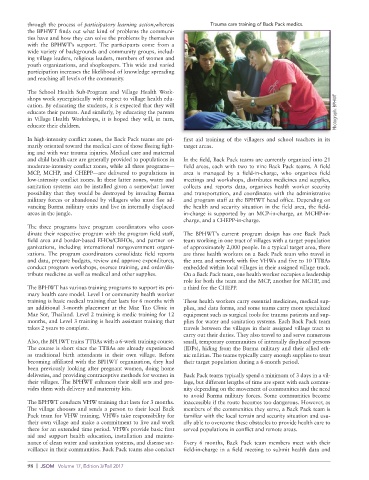
through the process of participatory learning action,whereas   Trauma care training of Back Pack medics.
          the BPHWT finds out what kind of problems the communi-
          ties have and how they can solve the problems by themselves
          with  the  BPHWT’s  support.  The  participants  come  from  a
          wide variety of backgrounds and community groups, includ-
          ing village leaders, religious leaders, members of women and
          youth organizations, and shopkeepers. This wide and varied
          participation increases the likelihood of knowledge spreading
          and reaching all levels of the community.

          The School Health Sub-Program and Village Health Work-
          shops work synergistically with respect to village health edu-
          cation. By educating the students, it is expected that they will
          educate their parents. And similarly, by educating the parents                                       Photograph: BPHWT
          in Village Health Workshops, it is hoped they will, in turn,
          educate their children.

          In high-intensity conflict zones, the Back Pack teams are pri-  first aid training of the villagers and school teachers in its
          marily oriented toward the medical care of those fleeing fight-  target areas.
          ing and with war trauma injuries. Medical care and maternal
          and child health care are generally provided to populations in   In the field, Back Pack teams are currently organized into 21
          moderate-intensity conflict zones, while all three programs—  field areas, each with two to nine Back Pack teams. A field
          MCP, MCHP, and CHEPP—are delivered to populations in   area  is  managed  by  a  field-in-charge,  who  organizes  field
          low-intensity conflict zones. In these latter zones, water and   meetings and workshops, distributes medicines and supplies,
          sanitation systems can be installed given a somewhat lower   collects and reports data, organizes health worker security
          possibility that they would be destroyed by invading Burma   and transportation, and coordinates with the administrative
          military forces or abandoned by villagers who must flee ad-  and program staff at the BPHWT head office. Depending on
          vancing Burma military units and live in internally displaced   the health and security situation in the field area, the field-
          areas in the jungle.                               in-charge is supported by an MCP-in-charge, an MCHP-in-
                                                             charge, and a CHEPP-in-charge.
          The three programs have program coordinators who coor-
          dinate their respective program with the program field staff,   The BPHWT’s current program design has one Back Pack
          field area and border-based EHOs/CBHOs, and partner or-  team working in one tract of villages with a target population
          ganizations,  including  international  nongovernment  organi-  of approximately 2,000 people. In a typical target area, there
          zations. The program coordinators consolidate field reports   are three health workers on a Back Pack team who travel in
          and data, prepare budgets, review and approve expenditures,   the area and network with five VHWs and five to 10 TTBAs
          conduct program workshops, oversee training, and order/dis-  embedded within local villages in their assigned village track.
          tribute medicine as well as medical and other supplies.  On a Back Pack team, one health worker occupies a leadership
                                                             role for both the team and the MCP, another for MCHP, and
          The BPHWT has various training programs to support its pri-  a third for the CHEPP.
          mary health care model. Level I or community health worker
          training is basic medical training that lasts for 6 months with   These health workers carry essential medicines, medical sup-
          an additional 3-month placement at the Mae Tao Clinic in   plies, and data forms, and some teams carry more specialized
          Mae Sot, Thailand. Level 2 training is medic training for 12   equipment such as surgical tools for trauma patients and sup-
          months, and Level 3 training is health assistant training that   plies for water and sanitation systems. Each Back Pack team
          takes 2 years to complete.                         travels between the villages in their assigned village tract to
                                                             carry out their duties. They also travel to and serve numerous
          Also, the BPHWT trains TTBAs with a 6-week training course.   small, temporary communities of internally displaced persons
          The course is short since the TTBAs are already experienced   (IDPs), hiding from the Burma military and their allied eth-
          as  traditional  birth  attendants  in  their  own  village.  Before   nic militias. The teams typically carry enough supplies to treat
          becoming affiliated with the BPHWT organization, they had   their target population during a 6-month period.
          been previously looking after pregnant women, doing home
          deliveries, and providing contraceptive methods for women in   Back Pack teams typically spend a minimum of 3 days in a vil-
          their villages. The BPHWT enhances their skill sets and pro-  lage, but different lengths of time are spent with each commu-
          vides them with delivery and maternity kits.       nity depending on the movement of communities and the need
                                                             to avoid Burma military forces. Some communities become
          The BPHWT conducts VHW training that lasts for 3 months.   inaccessible if the route becomes too dangerous. However, as
          The village chooses and sends a person to their local Back   members of the communities they serve, a Back Pack team is
          Pack team for VHW training. VHWs take responsibility for   familiar with the local terrain and security situation and usu-
          their own village and make a commitment to live and work   ally able to overcome these obstacles to provide health care to
          there for an extended time period. VHWs provide basic first   served populations in conflict and remote areas.
          aid  and support  health  education, installation  and mainte-
          nance of clean water and sanitation systems, and disease sur-  Every 6 months, Back Pack team members meet with their
          veillance in their communities. Back Pack teams also conduct   field-in-charge in a field meeting to submit health data and

          98  |  JSOM   Volume 17, Edition 3/Fall 2017

