


Page 97 - Journal of Special Operations Medicine - Fall 2017
P. 97
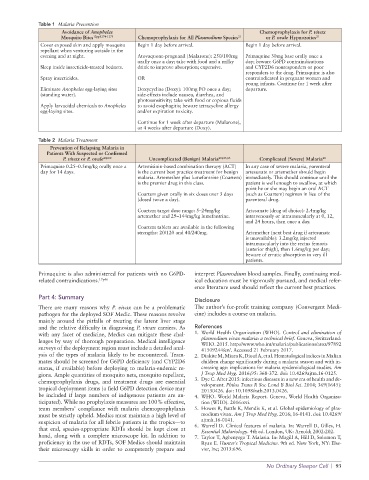
Table 1  Malaria Prevention
                     Avoidance of Anopheles                                           Chemoprophylaxis for P. vivax
                     Mosquito Bites 12pp1274-1275  Chemoprophylaxis for All Plasmodium Species 21  or P. ovale Hypnozoites 21
              Cover exposed skin and apply mosquito   Begin 1 day before arrival.  Begin 1 day before arrival.
              repellant when venturing outside in the
              evening and at night.           Atovaquone-proguanil (Malarone): 250/100mg   Primaquine 30mg base orally once a
                                              orally once a day; take with food and a milky   day; beware G6PD contraindications
              Sleep inside insecticide-treated bednets.  drink to improve absorption; expensive.  and CYP2D6 nonresponders or poor
                                                                                 responders to the drug. Primaquine is also
              Spray insecticides.             OR                                 contraindicated in pregnant women and
                                                                                 young infants. Continue for 1 week after
              Eliminate Anopheles egg-laying sites   Doxycycline (Doxy): 100mg PO once a day;   departure.
              (standing water).               side-effects include nausea, diarrhea, and
                                              photosensitivity; take with food or copious fluids
              Apply larvacidal chemicals to Anopheles   to avoid esophagitis; beware tetracycline allergy
              egg-laying sites.               and/or expiration toxicity.
                                              Continue for 1 week after departure (Malarone),
                                              or 4 weeks after departure (Doxy).

              Table 2  Malaria Treatment
                 Prevention of Relapsing Malaria in
                Patients With Suspected or Confirmed
                      P. vivax or P. ovale 20p60  Uncomplicated (Benign) Malaria 20p35,63  Complicated (Severe) Malaria 21
              Primaquine 0.25–0.5mg/kg orally once a   Artemisinin-based combination therapy (ACT)   In any case of severe malaria, parenteral
              day for 14 days.                is the current best practice treatment for benign   artesunate or artemether should begin
                                              malaria. Artemether plus lumefantrine (Coartem)  immediately. This should continue until the
                                              is the premier drug in this class.  patient is well enough to swallow, at which
                                                                                 point he or she may begin an oral ACT
                                              Coartem given orally in six doses over 3 days   (such as Coartem) regimen in lieu of the
                                              (dosed twice a day).               parenteral drug.
                                              Coartem target dose range: 5–24mg/kg   Artesunate (drug of choice): 2.4mg/kg
                                              artemether and 29–144mg/kg lumefantrine.  intravenously or intramuscularly at 0, 12,
                                                                                 and 24 hours, then once a day.
                                              Coartem tablets are available in the following
                                              strengths: 20/120 and 40/240mg.    Artemether (next best drug if artesunate
                                                                                 is unavailable): 3.2mg/kg injected
                                                                                 intramuscularly into the rectus femoris
                                                                                 (anterior thigh), then 1.6mg/kg per day;
                                                                                 beware of erratic absorption in very ill
                                                                                 patients.

                Primaquine is also administered for patients with no G6PD-  interpret Plasmodium blood samples. Finally, continuing med-
              related contraindications. 17p46                   ical education must be vigorously pursued, and medical refer-
                                                                 ence literature used should reflect the current best practices.
              Part 4: Summary                                    Disclosure
              There are many reasons why P. vivax can be a problematic   The author’s for-profit training company (Convergent Medi-
              pathogen for the deployed SOF Medic. These reasons revolve   cine) includes a course on malaria.
              mainly around the pitfalls of treating the latent liver stage
              and the relative difficulty in diagnosing P. vivax carriers. As   References
              with any facet of medicine, Medics can mitigate these chal-  1.  World Health Organization (WHO). Control and elimination of
              lenges by way of thorough preparation. Medical intelligence   plasmodium vivax malaria: a technical brief. Geneva, Switzerland:
                                                                   WHO. 2015. http://www.who.int/malaria/publications/atoz/97892
              surveys of the deployment region must include a detailed anal-  41509244/en/. Accessed 21 February 2017.
              ysis of the types of malaria likely to be encountered. Team-  2.  Diakite M, Miura K, Diouf A, et al. Hematological indices in Malian
              mates should be screened for G6PD deficiency (and CYP2D6   children change significantly during a malaria season and with in-
              status, if available) before deploying to malaria-endemic re-  creasing age: implications for malaria epidemiological studies. Am
              gions. Ample quantities of mosquito nets, mosquito repellant,   J Trop Med Hyg. 2016;95: 368-372. doi: 10.4269ajtm.16-0125.
                chemoprophylaxis  drugs,  and  treatment  drugs  are  essential   3.  Dye C. After 2015: infectious diseases in a new era of health and de-
              tropical deployment items (a field G6PD detection device may   velopment. Philos Trans R Soc Lond B Biol Sci. 2014; 369(1645):
                                                                   20130426. doi: 10.1098/rstb.2013.0426.
              be included if large numbers of indigenous patients are an-  4.  WHO. World Malaria Report. Geneva, World Health Organiza-
              ticipated). While no prophylaxis measures are 100% effective,   tion (WHO). 2016:xvi.
              team members’ compliance  with  malaria chemoprophylaxis   5.  Howes R, Battle K, Mendis K, et al. Global epidemiology of plas-
              must be strictly upheld. Medics must maintain a high level of   modium vivax. Am J Trop Med Hyg. 2016; 16-0141. doi: 10.4269/
              suspicion of malaria for all febrile patients in the tropics—to   ajtmh.16-0141.
              that end, species-appropriate  RDTs should be kept close at   6.  Warrell D. Clinical features of malaria. In: Warrell D, Gilles, H.
                                                                   Essential Malariology. 4th ed. London, UK: Arnold; 2002:202.
              hand, along with a complete microscope kit. In addition to   7.  Taylor T, Agbenyega T. Malaria. In: Magill A, Hill D, Solomon T,
              proficiency in the use of RDTs, SOF Medics should maintain   Ryan E. Hunter’s Tropical Medicine. 9th ed. New York, NY: Else-
              their microscopy skills in order to competently prepare and   vier, Inc; 2013:696.

                                                                                        No Ordinary Sleeper Cell  |  93

