


Page 92 - Journal of Special Operations Medicine - Fall 2017
P. 92
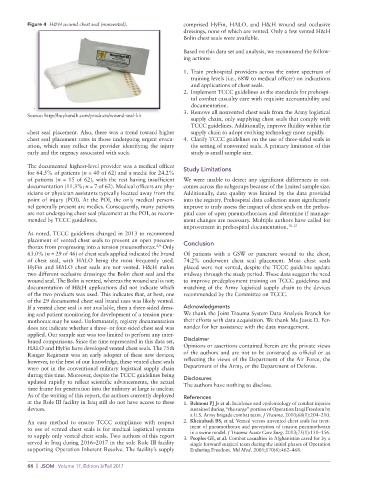
Figure 4  H&H wound chest seal (nonvented).        comprised  HyFin,  HALO,  and H&H  wound  seal occlusive
                                                             dressings, none of which are vented. Only a few vented H&H
                                                             Bolin chest seals were available.

                                                             Based on this data set and analysis, we recommend the follow-
                                                             ing actions:

                                                             1.  Train prehospital providers across the entire spectrum of
                                                               training levels (i.e., 68W to medical officer) on indications
                                                               and applications of chest seals.
                                                             2.  Implement TCCC guidelines as the standards for prehospi-
                                                               tal combat casualty care with requisite accountability and
                                                               documentation.
                                                             3.  Remove all nonvented chest seals from the Army logistical
          Source: http://buyhandh.com/products/wound-seal-kit
                                                               supply chain, only supplying chest seals that comply with
                                                               TCCC guidelines. Additionally, improve fluidity within the
          chest seal placement. Also, there was a trend toward higher   supply chain to adopt evolving technology more rapidly.
          chest seal placement rates in those undergoing urgent evacu-  4.  Clarify TCCC guidelines on the use of three-sided seals in
          ation, which may reflect the provider identifying the injury   the setting of nonvented seals. A primary limitation of this
          early and the urgency associated with such.          study is small sample size.

          The documented highest-level provider was a medical officer   Study Limitations
          for 64.5% of patients (n = 40 of 62) and a medic for 24.2%
          of patients (n = 15 of 62), with the rest having insufficient   We were unable to detect any significant differences in out-
          documentation (11.3%; n = 7 of 62). Medical officers are phy-  comes across the subgroups because of the limited sample size.
          sicians or physician assistants typically located away from the   Additionally, data quality was limited by the data provided
          point of injury (POI). At the POI, the only medical person-  into the registry. Prehospital data collection must significantly
          nel generally present are medics. Consequently, many patients   improve to truly assess the impact of chest seals on the prehos-
          are not undergoing chest seal placement at the POI, as recom-  pital care of open pneumothoraces and determine if manage-
          mended by TCCC guidelines.                         ment changes are necessary. Multiple authors have called for
                                                             improvement in prehospital documentation. 10–12
          As noted, TCCC guidelines changed in 2013 to recommend
          placement of vented chest seals to prevent an open pneumo-  Conclusion
          thorax from progressing into a tension pneumothorax.  Only
                                                    2,9
          63.0% (n = 29 of 46) of chest seals applied indicated the brand   Of patients with a GSW or puncture wound to the chest,
          of chest seal, with HALO being the most frequently used.   74.2% underwent chest seal placement. Most chest seals
          HyFin and HALO chest seals are not vented. H&H makes   placed were not vented, despite the TCCC guideline update
          two different occlusive dressings: the Bolin chest seal and the   midway through the study period. These data suggest the need
          wound seal. The Bolin is vented, whereas the wound seal is not;   to improve predeployment training on TCCC guidelines and
          documentation of H&H applications did not indicate which   matching of the Army logistical supply chain to the devices
          of the two products was used. This indicates that, at best, one   recommended by the Committee on TCCC.
          of the 29 documented chest seal brand uses was likely vented.
          If a vented chest seal is not available, then a three-sided dress-  Acknowledgments
          ing and patient monitoring for development of a tension pneu-  We thank the Joint Trauma System Data Analysis Branch for
          mothorax may be used. Unfortunately, registry documentation   their efforts with data acquisition. We thank Ms Jessie D. Fer-
          does not indicate whether a three- or four-sided chest seal was   nandez for her assistance with the data management.
          applied. Our sample size was too limited to perform any inter-
          brand comparisons. Since the time represented in this data set,   Disclaimer
          HALO and HyFin have developed vented chest seals. The 75th   Opinions or assertions contained herein are the private views
          Ranger Regiment was an early adopter of these new devices;   of the authors and are not to be construed as official or as
          however, to the best of our knowledge, these vented chest seals   reflecting the views of the Department of the Air Force, the
          were not in the conventional military logistical supply chain   Department of the Army, or the Department of Defense.
          during this time. Moreover, despite the TCCC guidelines being
          updated rapidly to reflect scientific advancements, the actual   Disclosures
                                                             The authors have nothing to disclose.
          time frame for penetration into the military at large is unclear.
          As of the writing of this report, the authors currently deployed   References
          at the Role III facility in Iraq still do not have access to these   1.  Belmont PJ Jr et al. Incidence and epidemiology of combat injuries
          devices.                                             sustained during “the surge” portion of Operation Iraqi Freedom by
                                                               a U.S. Army brigade combat team. J Trauma. 2010;68(1):204–210.
          An easy method to ensure TCCC  compliance with respect   2.  Kheirabadi BS, et al. Vented versus unvented chest seals for treat-
          to use of vented chest seals is for medical logistical systems   ment of pneumothorax and prevention of tension pneumothorax
                                                               in a swine model. J Trauma Acute Care Surg. 2013;75(1):150–156.
          to supply only vented chest seals. Two authors of this report   3.  Peoples GE, et al. Combat casualties in Afghanistan cared for by a
          served in Iraq during 2016–2017 in the sole Role III facility   single forward surgical team during the initial phases of Operation
          supporting Operation Inherent Resolve. The facility’s supply   Enduring Freedom. Mil Med. 2005;170(6):462–468.

          88  |  JSOM   Volume 17, Edition 3/Fall 2017

