


Page 91 - Journal of Special Operations Medicine - Fall 2017
P. 91
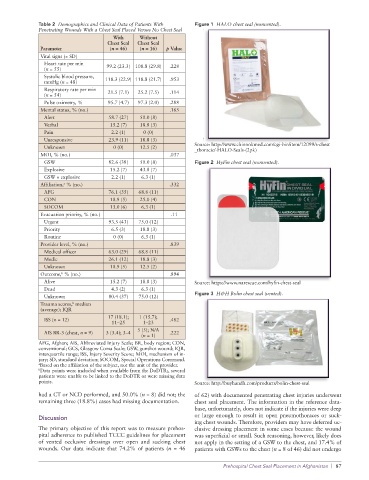
Table 2  Demographics and Clinical Data of Patients With   Figure 1  HALO chest seal (nonvented).
              Penetrating Wounds With a Chest Seal Placed Versus No Chest Seal
                                      With     Without
                                    Chest Seal    Chest Seal
              Parameter              (n = 46)  (n = 16)  p Value
              Vital signs (± SD)
               Heart rate per min    99.2 (23.3)  108.8 (29.8)  .228
               (n = 55)
               Systolic blood pressure,   118.3 (22.9) 118.8 (21.7)  .953
               mmHg (n = 48)
               Respiratory rate per min
               (n = 54)             21.5 (7.1)  25.2 (7.5)  .114
               Pulse oximetry, %    95.7 (4.7)  97.3 (2.0)  .288
              Mental status, % (no.)                    .165
               Alert                 58.7 (27)  50.0 (8)
               Verbal                15.2 (7)  18.8 (3)
               Pain                  2.2 (1)    0 (0)
               Unresponsive          23.9 (11)  18.8 (3)
               Unknown                0 (0)    12.5 (2)          Source: http://www.chinookmed.com/cgi-bin/item/12099/s-chest
                                                                 _thoracic/-HALO-Seals-(2pk)
              MOI, % (no.)                              .037
               GSW                   82.6 (38)  50.0 (8)         Figure 2  HyFin chest seal (nonvented).
               Explosive             15.2 (7)  43.8 (7)
               GSW + explosive       2.2 (1)   6.3 (1)
              Affiliation,  % (no.)                     .332
                      a
               AFG                   76.1 (35)  68.8 (11)
               CON                   10.9 (5)  25.0 (4)
               SOCOM                 13.0 (6)  6.3 (1)
              Evacuation priority, % (no.)               .11
               Urgent                93.5 (43)  75.0 (12)
               Priority              6.5 (3)   18.8 (3)
               Routine                0 (0)    6.3 (1)
              Provider level, % (no.)                   .839
               Medical officer       63.0 (29)  68.8 (11)
               Medic                 26.1 (12)  18.8 (3)
               Unknown               10.9 (5)  12.5 (2)
              Outcome,  % (no.)                         .894
                     b
               Alive                 15.2 (7)  18.8 (3)          Source: https://www.narescue.com/hyfin-chest-seal
               Dead                  4.3 (2)   6.3 (1)
                                                                 Figure 3  H&H Bolin chest seal (vented).
               Unknown               80.4 (37)  75.0 (12)
                         b
              Trauma scores,  median
              (average); IQR
                                    17 (18.1);   1 (15.7);
               ISS (n = 12)                             .482
                                      11–25     1–23
                                              5 (5); N/A
               AIS BR-3 (chest, n = 9)  3 (3.4); 3–4    .222
                                               (n = 1)
              AFG, Afghan; AIS, Abbreviated Injury Scale; BR, body region; CON,
              conventional; GCS, Glasgow Coma Scale; GSW, gunshot wound; IQR,
              interquartile range; ISS, Injury Severity Score; MOI, mechanism of in-
              jury; SD, standard deviation; SOCOM, Special Operations Command.
              a Based on the affiliation of the subject, not the unit of the provider.
              b Data points were included when available from the DoDTR;, several
              patients were unable to be linked to the DoDTR or were missing data
              points.                                            Source: http://buyhandh.com/products/bolin-chest-seal

              had a CT or NCD performed, and 50.0% (n = 8) did not; the   of 62) with documented penetrating chest injuries underwent
              remaining three (18.8%) cases had missing documentation.  chest seal placement. The information in the reference data-
                                                                 base, unfortunately, does not indicate if the injuries were deep
              Discussion                                         or large enough to result in open pneumothoraces or suck-
                                                                 ing chest wounds. Therefore, providers may have deferred oc-
              The primary objective of this report was to measure prehos-  clusive dressing placement in some cases because the wound
              pital adherence to published TCCC guidelines for placement   was superficial or small. Such reasoning, however, likely does
              of  vented  occlusive  dressings  over  open  and  sucking  chest   not apply in the setting of a GSW to the chest, and 17.4% of
              wounds. Our data indicate that 74.2% of patients (n = 46     patients with GSWs to the chest (n = 8 of 46) did not undergo

                                                                          Prehospital Chest Seal Placement in Afghanistan  |  87

