


Page 90 - Journal of Special Operations Medicine - Fall 2017
P. 90
Data Registries                                    Table 1  Overall Demographics
                                                                        Category                 % (No.)
          PHTR description                                    MOI
          The JTS PHTR is a data collection and analytic system de-
          signed to provide near real-time feedback to commanders. The     Explosive            22.6 (14)
          primary purposes of this system are to improve casualty visibil-    GSW               74.2 (46)
          ity, augment command decision-making processes, and direct     GSW + explosive         3.2 (2)
          procurement of medical assets. Additionally, this system seeks   Affiliation
          to improve morbidity and mortality through performance im-    SOCOM                    11.3 (7)
          provement in the areas of primary prevention (i.e., tactics, tech-    CON              15.5 (9)
          niques, and procedures), secondary prevention (i.e., personal     AFG                 74.2 (46)
          protective equipment), and tertiary prevention (i.e., casualty re-  Injury class
          sponse system and TCCC). Central Command and their Joint     Battle injury            96.8 (60)
          Theater Trauma System capture all prehospital trauma care     Nonbattle injury         3.2 (2)
          provided on the ground by all services in the Afghanistan The-
          ater. TCCC cards, DD 1380 forms, and TCCC After-Action   Evacuation priority
          Reports (AARs) provide the registry data. The PHTR was in     Urgent                  88.7 (55)
          existence from January 2013 to September 2014.        Priority                         6.5 (4)
                                                                Routine                          4.8 (3)
          DoDTR description                                   Highest provider level a
          The DoDTR, formerly known as the Joint Theater Trauma     Medical officer             64.5 (40)
          Registry, is the data repository for DoD trauma-related inju-    Medic                24.2 (15)
          ries.  The  DoDTR  includes  documentation  regarding  demo-    Unknown                11.3 (7)
          graphics, injury-producing incidents, diagnoses, treatments,   AFG, Afghan; CON, conventional;  GSW, gunshot wound;  MOI,
          and outcomes of injuries sustained by U.S./non-U.S. military   mechanism of injury; SOCOM, Special Operations Command.
          and U.S./non-U.S. civilian personnel in wartime and peacetime   a Data fields were missing for seven patients.
          from the point of injury to final disposition.
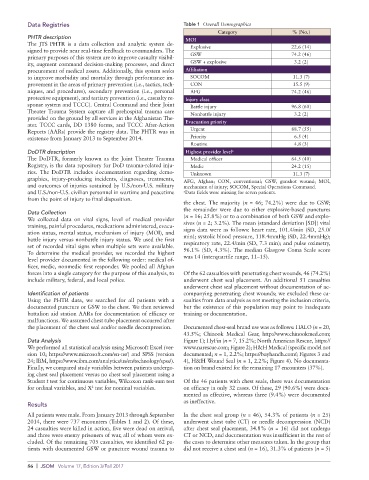
                                                             the chest. The majority (n = 46; 74.2%) were due to GSW;
                                                             the  remainder were  due  to either  explosive-based  punctures
          Data Collection
          We collected data on vital signs, level of medical provider   (n = 16; 25.8%) or to a combination of both GSW and explo-
          training, painful procedures, medications administered, evacu-  sives (n = 2; 3.2%). The mean (standard deviation [SD]) vital
          ation status, mental status, mechanism of injury (MOI), and   signs data were as follows: heart rate, 101.4/min (SD, 25.0/
          battle injury versus nonbattle injury status. We used the first   min); systolic blood pressure, 118.4mmHg (SD, 22.4mmHg);
          set of recorded vital signs when multiple sets were available.   respiratory rate, 22.4/min (SD, 7.3 min); and pulse oximetry,
          To determine the medical provider, we recorded the highest   96.1% (SD, 4.3%). The median Glasgow Coma Scale score
          level provider documented in the following order: medical of-  was 14 (interquartile range, 11–15).
          ficer, medic, nonmedic first responder. We pooled all Afghan
          forces into a single category for the purpose of this analysis, to   Of the 62 casualties with penetrating chest wounds, 46 (74.2%)
          include military, federal, and local police.       underwent chest seal placement. An additional 51 casualties
                                                             underwent chest seal placement without documentation of ac-
          Identification of patients                         companying penetrating chest wounds; we excluded these ca-
          Using the PHTR data, we searched for all patients with a   sualties from data analysis as not meeting the inclusion criteria,
          documented puncture or GSW to the chest. We then reviewed   but the existence of this population may point to inadequate
          battalion aid station AARs for documentation of efficacy or   training or documentation.
          malfunctions. We assumed chest tube placement occurred after
          the placement of the chest seal and/or needle decompression.  Documented chest-seal brand use was as follows: HALO (n = 20,
                                                             43.5%; Chinook Medical Gear,  http://www.chinookmed.com;
          Data Analysis                                      Figure 1); HyFin (n = 7, 15.2%; North American Rescue, https://
          We performed all statistical analysis using Microsoft Excel (ver-  www.narescue.com; Figure 2); H&H Medical (specific model not
          sion 10; https://www.microsoft.com/en-us/) and SPSS (version    documented; n = 1, 2.2%; https://buyhandh.com/; Figures 3 and
          24; IBM, https://www.ibm.com/analytics/us/en/technology/spss/).     4), H&H Wound Seal (n = 1, 2.2%; Figure 4). No documenta-
          Finally, we compared study variables between patients undergo-  tion on brand existed for the remaining 17 encounters (37%).
          ing chest seal placement versus no chest seal placement using a
          Student t test for continuous variables, Wilcoxon rank-sum test   Of the 46 patients with chest seals, there was documentation
          for ordinal variables, and Χ  test for nominal variables.  on efficacy in only 32 cases. Of these, 29 (90.6%) were docu-
                               2
                                                             mented as effective, whereas three (9.4%) were documented
                                                             as ineffective.
          Results
          All patients were male. From January 2013 through September   In the chest seal group (n = 46), 54.3% of patients (n = 25)
          2014, there were 737 encounters (Tables 1 and 2). Of these,   underwent chest tube (CT) or needle decompression (NCD)
          24 casualties were killed in action, five were dead on arrival,   after chest seal placement, 34.8% (n = 16) did not undergo
          and three were enemy prisoners of war, all of whom were ex-  CT or NCD, and documentation was insufficient in the rest of
          cluded. Of the remaining 705 casualties, we identified 62 pa-  the cases to determine other measures taken. In the group that
          tients with documented GSW or puncture wound trauma to   did not receive a chest seal (n = 16), 31.3% of patients (n = 5)

          86  |  JSOM   Volume 17, Edition 3/Fall 2017

