


Page 50 - Journal of Special Operations Medicine - Spring 2017
P. 50
Exposure to the environment was made by placing the   the two users. Thus, both users performed 150 tests, 75
          study group of tourniquets on the metal roof of a home   tests each in the control and study groups.
          in the center of San Antonio, Texas. The unexposed con-
          trol group was stored in a climate-controlled laboratory.   The order in which the devices were tested was random-
          The two groups of tourniquets were purchased simulta-  ized such that the control group and study group were
          neously from the same lots and batches and were concur-  assessed concurrently. User order was one at a time and
          rently exposed or stored. The exposure began 3 July 2013   as allowed by the individual’s schedule. The scientist
          and ended 2 January 2015 (i.e., 548 days, or 18 months).  performed the first test, the cadet (user 2) made the next
                                                             150 tests, and the scientist finished with his 149 remain-
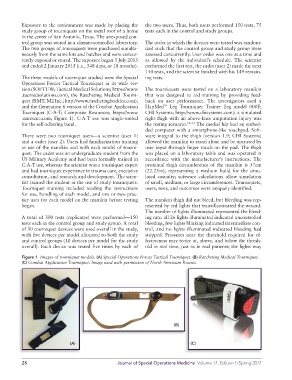
          The three models of tourniquet studied were the Special   ing tests.
          Operations Forces Tactical Tourniquet in its wide ver-
          sion (SOFTT-W; Tactical Medical Solutions; https://www   The tourniquets were tested on a laboratory manikin
          .tacmedsolutions.com),  the  Ratcheting  Medical  Tourni-  that  was  designed  to  aid  training  by providing  feed-
          quet (RMT; M2 Inc.; http://www.ratchetingbuckles.com),   back on user performance.  The investigators used  a
                                                                     ™
          and the Generation 6 version of the Combat Application   HapMed  Leg Tourniquet Trainer (leg model 000F;
          Tourniquet (C-A-T; Composite Resources; https://www   CHI Systems; http://www.chisystems.com); a simulated
          .narescue.com; Figure 1). C-A-T use was single-routed   right-thigh with an above-knee amputation injury was
          for the self-adhering band.                        the testing scenario. 10–13  The medial hip had an embed-
                                                             ded computer with a smartphone-like touchpad. Soft-
          There  were  two  tourniquet  users—a  scientist  (user  1)   ware integral to the thigh (version 1.9; CHI Systems)
          and a cadet (user 2). Users had familiarization training   allowed the manikin to stand alone and be operated by
          in use of the manikin and with each model of tourni-  user input through finger touch on the pad. The thigh
          quet. The cadet was an undergraduate student from the   was placed on a laboratory table and was operated in
          US Military Academy and had been formally trained in   accordance with the manufacturer’s instructions.  The
          C-A-T use, whereas the scientist was a tourniquet expert   proximal thigh circumference of the manikin is 57cm
          and had tourniquet experience in trauma care, executive   (22.25in), representing a medium build for the simu-
          consultation, and research and development. The scien-  lated casualty; software calculations allow simulation
          tist trained the student in the use of study tourniquets.   of small, medium, or large circumferences. Tourniquets,
          Tourniquet training included reading the instructions   users, tests, and outcomes were uniquely identified.
          for use, handling of each model, and one or two prac-
          tice uses for each model on the manikin before testing   The manikin thigh did not bleed, but bleeding was rep-
          began.                                             resented by red lights that transilluminated the wound.
                                                             The number of lights illuminated represented the bleed-
          A total of 300 tests (replicates) were performed—150   ing rate: all 26 lights illuminated indicated uncontrolled
          tests each in the control group and study group. A total   bleeding, few lights blinking indicated intermediate con-
          of 30 tourniquet devices were used overall in the study,   trol, and no lights illuminated indicated bleeding had
          with five devices per model allocated to both the study   stopped. Pressures near the threshold required for ef-
          and control groups (10 devices per model for the study   fectiveness may  teeter at, above, and below the thresh-
          overall). Each device was tested five times by each of   old in real time, just as in real patients; the lights may

          Figure 1  Images of tourniquet models. (A) Special Operations Forces Tactical Tourniquet. (B) Ratcheting Medical Tourniquet.
          (C) Combat Application Tourniquet. Image used with permission of North American Rescue.


                                                                         (B)


                              (A)                                               (C)


          28                                      Journal of Special Operations Medicine  Volume 17, Edition 1/Spring 2017

