


Page 54 - Journal of Special Operations Medicine - Spring 2017
P. 54
Blood Loss:                                        Figure 4  Blood loss results by user.*
          Results Overall and by Tourniquet Model
          For the overall study, 50% of the variance of the blood
          loss volume results could be attributed to the users.
          Among the 256 effective tests, the mean blood loss for
          all three tourniquet models was 163mL. There was no
          significant difference between unexposed and exposed
          devices in mean blood loss, which were 162mL and
          173mL for unexposed and exposed devices, respectively
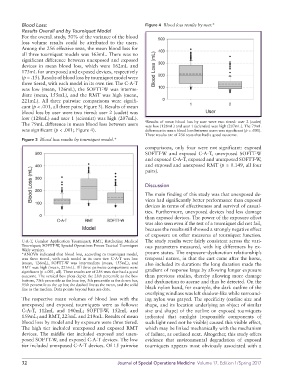
          (p = .15). Results of blood loss by tourniquet model were
          three tiered, with each model in its own tier. The C-A-T
          was low (mean, 126mL), the SOFTT-W was interme-
          diate (mean, 155mL), and the RMT was high (mean,
          221mL). All three pairwise comparisons were signifi-
          cant (p < .001, all three pairs; Figure 3). Results of mean
          blood loss by user were two tiered: user 2 (cadet) was
          low (128mL) and user 1 (scientist) was high (207mL).   a
                                                             Results of mean blood loss by user were two tiered: user 2 (cadet)
          The 79mL difference in mean blood loss between users   was low (128mL) and user 1 (scientist) was high (207mL). The 79mL
          was significant (p < .001; Figure 4).              difference in mean blood loss between users was significant (p < .001).
                                                             These results are of 256 tests that had a good outcome.
          Figure 3  Blood loss results by tourniquet model.*
                                                             comparisons,  only  four  were  not significant:  exposed
                                                             SOFTT-W and exposed C-A-T, unexposed SOFTT-W
                                                             and exposed C-A-T, exposed and unexposed SOFTT-W,
                                                             and exposed and unexposed RMT (p ≥ 0.149, all four
                                                             pairs).


                                                             Discussion
                                                             The main finding of this study was that unexposed de-
                                                             vices had significantly better performance than exposed
                                                             devices in terms of effectiveness and survival of casual-
                                                             ties. Furthermore, unexposed devices had less damage
                                                             than exposed devices. The power of the exposure effect
                                                             was also seen even if the test of a tourniquet did not fail,
                                                             because the results still showed a strongly negative effect
                                                             of exposure on other measures of tourniquet function.
          C-A-T, Combat Application Tourniquet; RMT, Ratcheting Medical   The study results were fairly consistent across the vari-
          Tourniquet; SOFTT-W, Special Operations Forces Tactical Tourniquet   ous parameters measured, with big differences by ex-
          Wide version.                                      posure status. The exposure–dysfunction relationship’s
          *ANOVA indicated that blood loss, according to tourniquet model,
          was three tiered, with each model in its own tier: C-A-T was low   temporal nature, in that the cart came after the horse,
          (mean,  126mL), SOFTT-W was  intermediate  (mean, 155mL),  and   also included its duration: the long duration made the
          RMT was high (mean, 221mL). All three pairwise comparisons were   gradient of response large by allowing longer exposure
          significant (p <.001, all). These results are of 256 tests that had a good
          outcome. The vertical box plots depict the 25th percentile as the box   than previous studies, thereby allowing more damage
          bottom, 75th percentile as the box top, 5th percentile as the down bar,   and dysfunction to accrue and thus be detected. On the
          95th percentile as the up bar, the dashed line as the mean, and the solid   black nylon band, for example, the dark outline of the
          line as the median. Data points beyond bars are dots.
                                                             overlying windlass was left shadow-like while surround-
          The respective mean volumes of blood loss with the   ing nylon was grayed. The specificity (outline size and
          unexposed and exposed tourniquets were as follows:    shape, and its location underlying an object of similar
          C-A-T, 112mL and 140mL; SOFTT-W, 152mL and         size and shape) of the outline on exposed tourniquets
          159mL; and RMT, 223mL and 219mL. Results of mean   indicated that sunlight (responsible  components of
          blood loss by model and by exposure were three tiered.   such light need not be visible) caused this visible effect,
          The high tier included unexposed and exposed RMT   which may be linked mechanically with the mechanism
          devices. The middle tier included exposed and unex-  of failure, as outlined next. Altogether, this study offers
          posed SOFTT-W, and exposed C-A-T devices. The low   evidence that environmental degradation of exposed
          tier included unexposed C-A-T devices. Of 15 pairwise   tourniquets  appears  most  obviously  associated  with  a


          32                                      Journal of Special Operations Medicine  Volume 17, Edition 1/Spring 2017

