


Page 148 - Journal of Special Operations Medicine - Spring 2017
P. 148
included four cases with acute gastroenteritis, one with   Table 4  Infil/Exfil Modes, Disposition, Duration and
          meningitis, one with dengue fever, one with Lyme dis-  Mortality
          ease, and one with flu-like illness and rash. The cardiac                                No. (%)
          case was acute chest pain with bradycardia. The other   Mode of PFC provider infiltration*
          etiologies were odynophagia and severe headache.
                                                              Already on the scene at the time of   22 (40.7)
          The PFC Environment                                 injury or illness
          The PFC provider was on the scene at the time of injury   Aircraft                      16 (29.6)
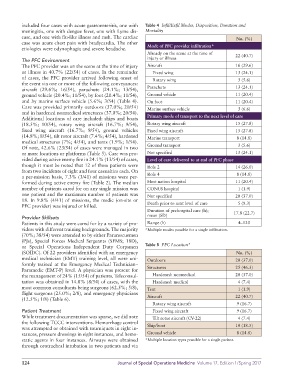
          or illness in 40.7% (22/54) of cases. In the remainder   Fixed wing                     13 (24.1)
          of cases, the PFC provider arrived following onset of   Rotary wing                      3 (5.6)
          the event via one or more of the following conveyances:
          aircraft (29.6%; 16/54), parachute (24.1%; 13/54),   Parachute                          13 (24.1)
          ground vehicle (20.4%; 11/54), by foot (20.4%; 11/54),   Ground vehicle                 11 (20.4)
          and by marine surface vehicle (5.6%; 3/54) (Table 4).   On foot                         11 (20.4)
          Care was provided primarily outdoors (37.0%; 20/54)   Marine surface vehicle             3 (6.6)
          and in hardened nonmedical structures (37.0%; 20/54).
          Additional locations of care included: ships and boats   Primary mode of transport to the next level of care
          (18.5%; 10/54), rotary wing aircraft (16.7%; 9/54),   Rotary wing aircraft              15 (27.8)
          fixed wing aircraft (16.7%; 9/54), ground vehicles   Fixed wing aircraft                15 (27.8)
          (14.8%; 8/54), tilt rotor aircraft (7.4%; 4/54), hardened   Marine transport             8 (14.8)
          medical structures (7%; 4/54), and tents (1.9%; 1/54).
          Of note, 42.6% (23/54) of cases were managed in two   Ground transport                   3 (5.6)
          or more locations or platforms (Table 5). Care was pro-  Not specified                  13 (24.1)
          vided during active enemy fire in 24.1% (13/54) of cases,   Level of care delivered to at end of PFC phase
          though it must be noted that 12 of these patients were   Role 2                         14 (26.0)
          from two incidents of eight and four casualties each. On   Role 4                        8 (14.8)
          a per-mission basis, 7.3% (3/41) of missions were per-
          formed during active enemy fire (Table 2). The median   Host nation hospital            11 (20.4)
          number of patients cared for on any single mission was   CONUS hospital                  1 (1.9)
          one patient and the maximum number of patients was   Not specified                      20 (37.0)
          18. In 9.8% (4/41) of missions, the medic (on-site or   Death prior to next level of care  5 (9.3)
          PFC provider) was injured or killed.
                                                              Duration of prehospital care (h);    17.8 (22.7)
          Provider Skillsets                                  mean (SD)
          Patients in this study were cared for by a variety of pro-  Range (h)                    4–120
          viders with different training backgrounds. The majority   *Multiple modes possible for a single infiltration.
          (70%; 38/54) were attended to by either Pararescuemen
          (PJs), Special Forces Medical Sergeants (SFMS; 18D),
          or Special Operations Independent Duty Corpsmen    Table 5  PFC Location*
          (SOIDC). Of 22 providers identified with an emergency                                    No. (%)
          medical technician (EMT) training level, all were uni-  Outdoors                        20 (37.0)
          formly trained at the Emergency Medical Technician–  Structures                         25 (46.3)
          Paramedic (EMT-P) level. A physician was present for
          the management of 24% (15/54) of patients. Teleconsul-  Hardened: nonmedical            20 (37.0)
          tation was obtained in 14.8% (8/54) of cases, with the   Hardened: medical               4 (7.4)
          most common consultants being surgeons (62.5%; 5/8),   Tent                              1 (1.9)
          flight surgeons (25.0%; 2/8), and emergency physicians   Aircraft                       22 (40.7)
          (12.5%; 1/8) (Table 6).
                                                                Rotary wing aircraft               9 (16.7)
          Patient Treatment                                     Fixed wing aircraft                9 (16.7)
          While treatment documentation was sparse, we did note   Tilt rotor aircraft (CV-22)      4 (7.4)
          the following TCCC interventions. Hemorrhage control   Ship/boat                        10 (18.5)
          was attempted or obtained with tourniquets in eight in-
          stances, pressure dressings in eight instances, and hemo-  Ground vehicle                8 (14.8)
          static agents in four instances. Airways were obtained   *Multiple location types possible for a single patient.
          through orotracheal intubation in two patients and via


          124                                     Journal of Special Operations Medicine  Volume 17, Edition 1/Spring 2017

