


Page 144 - Journal of Special Operations Medicine - Spring 2017
P. 144
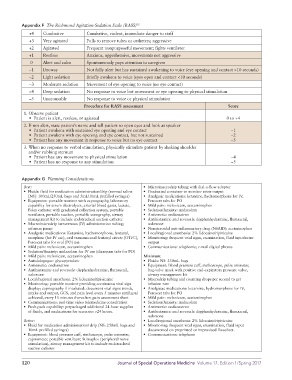
Appendix F  The Richmond Agitation-Sedation Scale (RASS) 12
             +4    Combative         Combative, violent, immediate danger to staff
             +3    Very agitated     Pulls to remove tubes or catheters; aggressive
             +2    Agitated          Frequent nonpurposeful movement; fights ventilator
             +1    Restless          Anxious, apprehensive, movements not aggressive
              0    Alert and calm    Spontaneously pays attention to caregiver
             −1    Drowsy            Not fully alert but has sustained awakening to voice (eye opening and contact >10 seconds)
             −2    Light sedation    Briefly awakens to voice (eyes open and contact <10 seconds)
             −3    Moderate sedation  Movement of eye opening to voice (no eye contact)
             −4    Deep sedation     No response to voice but movement or eye opening to physical stimulation
             −5    Unarousable       No response to voice or physical stimulation
                                    Procedure for RASS assessment                              Score
           1. Observe patient
             •  Patient is alert, restless, or agitated                                        0 to +4
           2. If not alert, state patient’s name and tell patient to open eyes and look at speaker
             •  Patient awakens with sustained eye opening and eye contact                      −1
             •  Patient awakens with eye opening and eye contact, but not sustained             −2
             •  Patient has any movement in response to voice but no eye contact                –3
           3.  When no response to verbal stimulation, physically stimulate patient by shaking shoulder
             and/or rubbing sternum
             •  Patient has any movement to physical stimulation                                −4
             •  Patient has no response to any stimulation                                      −5


          Appendix G  Planning Considerations

           Best:                                            •  Micro/macrodrip tubing with dial-a-flow adaptor
           •  Fluids: fluid for medication administration/drip (normal saline   •  Graduated container to monitor urine output
             [NS]: 100mL/250mL bags and 5mL/10mL prefilled syringes)   •  Analgesic medications: ketamine, hydromorphone for IV,
           •  Equipment: portable monitor with capnography, laboratory   Percocet tabs for PO
             capability for serum electrolytes, arterial blood gases, lactate,   •  Mild pain: meloxicam, acetaminophen
             Foley catheter with graduated collection system, portable   •  Sedation/Anxiety: midazolam
             ventilator, portable suction, portable sonography, airway   •  Antiemetic: ondansatron
             management kit to include endotracheal suction catheter  •  Antihistamine and reversals: diyphenhydramine, flumazenil,
           •  Macro/microdrip intravenous (IV) administration tubing;    naloxone
             infusion pump                                  •  Nonsteroidal anti-inflammatory drug (NSAID): acetminophen
           •  Analgesic medications: Ketamine, hydromorphone, fentanyl,   •  Local/regional anesthesia: 2% lidocaine/ripivicaine
             morphine (for IV use), oral transmucosal fentanyl citrate (OTFC),   •  Monitoring: frequent vital signs, examination, fluid input/urine
             Percocet tabs for oral (PO) use                  output
           •  Mild pain: meloxicam, acetaminophen           •  Communications: telephonic; e-mail digital photos
           •  Sedation/Anxiety: midazolam for IV use (diazepam tabs for PO)
           •  Mild pain: meloxicam, acetaminophen           Minimum:
           •  Antisialogogue: glycopyrrolate                •  Fluids: NS: 250mL bags
           •  Antiemetic: ondansatron                       •  Equipment: blood pressure cuff, stethoscope, pulse oximeter,
           •  Antihistamine and reversals: diyphenhydramine, flumazenil,   bag-valve mask with positive end-expiratory pressure valve,
             naloxone                                         airway management kit
           •  Local/regional anesthesia: 2% lidocaine/ripivicaine  •  Macrodrip tubing and counting drops per second to get
           •  Monitoring: portable monitor providing continuous vital sign   infusion rate
             display; capnography if intubated; document vital signs trends,   •  Analgisiac medications: ketamine, hydromorphone for IV,
             intake and output, GCS, and pain level every 5 minutes until goal   Percocet tabs for PO
             achieved, every 15 minutes thereafter; pain assessment sheet  •  Mild pain: meloxicam, acetaminophen
           •  Communications: real-time video telemedicine consultation  •  Sedation/Anxiety: midazolam
           •  Push-pack capability: prepackaged additional 24-hour supplies    •  Antiemetic: ondansatron
             of fluids, and medications for scenarios >24 hours.  •  Antihistamine and reversals: diyphenhydramine, flumazenil,
                                                              naloxone
           Better:                                          •  Local/regional anesthesia: 2% lidocaine/ripivicaine
           •  Fluid for medication administration/ drip (NS: 250mL bags and   •  Monitoring: frequent vital signs, examination, fluid input
             10mL prefilled syringes)                         documented on preprinted or improvised flowsheet.
           •  Equipment: blood pressure cuff, stethoscope, pulse oximeter,   •  Communications: telephone
             capnometer, portable ventilator, Stimuplex (peripheral nerve
             stimulation), airway management kit to include endotracheal
             suction catheter


          120                                     Journal of Special Operations Medicine  Volume 17, Edition 1/Spring 2017

