


Page 147 - Journal of Special Operations Medicine - Spring 2017
P. 147
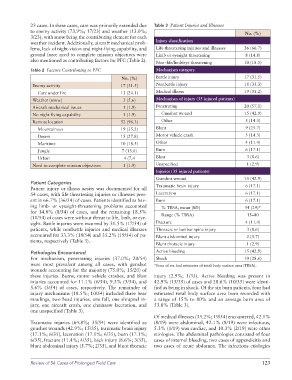
23 cases. In these cases, care was primarily extended due   Table 3  Patient Injuries and Illnesses
              to enemy activity (73.9%; 17/23) and weather (13.0%;                                    No. (%)
              3/23), with snow being the contributing element for each
              weather incident. Additionally, aircraft mechanical prob-  Injury classification
              lems, lack of night-vision and night-flying capability, and   Life-threatening injuries and illnesses  36 (66.7)
              ground force need to complete mission objectives were   Limb or eyesight threatening    8 (14.8)
              also mentioned as contributing factors for PFC (Table 2).  Non–life/limb/eye threatening  10 (18.5)
              Table 2  Factors Contributing to PFC               Mechanism category

                                                   No. (%)       Battle injury                        17 (31.5)
              Enemy activity                       17 (31.5)     Nonbattle injury                     18 (33.3)
                 Care under fire                   13 (24.1)     Medical illness                      19 (35.2)
              Weather (snow)                        3 (5.6)      Mechanism of injury (35 injured patients)
              Aircraft mechanical issues            1 (1.9)      Penetrating                          20 (57.1)
              No night flying capability            1 (1.9)         Gunshot wound                     15 (42.9)
              Remote location                      52 (96.3)        Other                             5 (14.3)
                 Mountainous                       19 (35.2)     Blunt                                9 (25.7)
                 Desert                            15 (27.8)     Motor vehicle crash                  5 (14.3)
                 Maritime                          10 (18.5)     Other                                4 (11.4)
                 Jungle                            7 (13.0)      Burn                                 6 (17.1)
                 Urban                              4 (7.4       Blast                                 3 (8.6)
              Need to complete mission objectives   1 (1.9)      Unspecified                           1 (2.9)
                                                                 Injuries (35 injured patients)
                                                                 Gunshot wound                        15 (42.9)
              Patient Categories                                 Traumatic brain injury               6 (17.1)
              Patient injury or illness acuity was documented for all
              54 cases, with life-threatening injuries or illnesses pres-  Laceration                 6 (17.1)
              ent in 66.7% (36/54) of cases. Patients identified as hav-  Burn                        6 (17.1)
              ing limb- or eyesight-threatening problems accounted   % TBSA, mean (SD)                54 (29)*
              for 14.8% (8/54) of cases, and the remaining 18.5%    Range (% TBSA)                     15–80
              (10/54) of cases were without threat to life, limb, or eye-
              sight. Battle injuries were incurred by 31.5% (17/54) of   Fracture                     4 (11.4)
              patients, while nonbattle injuries and medical illnesses   Thoracic or lumbar spine injury  3 (8.6)
              accounted for 33.3% (18/54) and 35.2% (19/54) of pa-  Blunt abdominal injury             2 (5.7)
              tients, respectively (Table 3).
                                                                 Blunt thoracic injury                 1 (2.9)
              Pathologies Encountered                            Active bleeding                      15 (42.9)
              For mechanism, penetrating injuries (37.0%; 20/54)   Shock                              10 (28.6)
              were  most  prevalent  among  all  cases,  with  gunshot   *Four of six had estimates of total body surface area (TBSA).
              wounds accounting for the majority (75.0%; 15/20) of
              these injuries. Burns, motor vehicle crashes, and blast   injury (2.9%; 1/35). Active bleeding was present in
              injuries accounted for 11.1% (6/54), 9.3% (5/54), and   42.9% (15/35) of cases and 28.6% (10/35) were identi-
              5.6% (3/54) of cases, respectively. The remainder of   fied as being in shock. Of the six burn patients, four had
              injury mechanisms (18.5%; 10/54) included three bear   estimated  total  body  surface  area  burn  recorded  with
              maulings, two head injuries, one fall, one shrapnel in-  a range of 15% to 80% and an average burn area of
              jury, one aircraft crash, one chainsaw laceration, and   53.8% (Table 3).
              one unspecified (Table 3).
                                                                 Of medical illnesses (35.2%; 19/54) encountered, 42.1%
              Traumatic  injuries  (64.8%; 35/54)  were  identified  as   (8/19) were abdominal, 42.1% (8/19) were infectious,
              gunshot wounds (42.9%; 15/35), traumatic brain injury   5.3% (1/19) was cardiac, and 10.3% (2/19) were other
              (17.1%; 6/35), laceration (17.1%; 6/35), burn (17.1%;   etiologies. The abdominal pathologies consisted of four
              6/35), fracture (11.4%; 4/35), back injury (8.6%; 3/35),   cases of internal bleeding, two cases of appendicitis and
              blunt abdominal injury (5.7%; 2/35), and blunt  thoracic   two cases of acute abdomen. The infections etiologies


              Review of 54 Cases of Prolonged Field Care                                                     123

