


Page 146 - Journal of Special Operations Medicine - Spring 2017
P. 146
Methods                                            one for lack of sufficient patient care details, three for
                                                             medical diagnoses that did not require urgent medical
          This study was approved as a performance improvement   evacuation (MEDEVAC), and one that described a mass
          project by the Department of Defense Joint Trauma System.
                                                             casualty incident with hundreds of patients without
                                                             means to adequately describe individual patient treat-
          A survey instrument was developed in order to afford   ment. Remaining were cases describing 54 patients from
          respondents  with the ability to transcribe  data from   41 separate MEDEVAC missions. The majority (96.3%;
          after-action reviews (AARs) in a standardized and uni-  52/54) were male with the exception of two female chil-
          form manner while also excluding classified or sensitive   dren. Ages ranged from 1 to 60 years with a mean age of
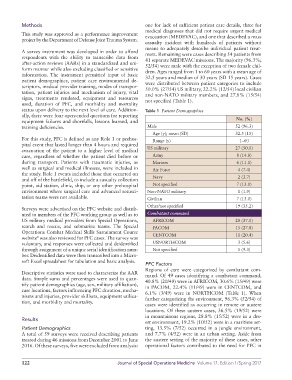
          information. The instrument permitted input of basic   32.5 years and median of 30 years (SD 15 years). Cases
          patient demographics, patient care environmental de-  were distributed between patient categories to include
          scriptors, medical provider training, modes of transpor-  50.0% (27/54) US military, 22.2% (12/54) local civilian
          tation, patient injuries and mechanism of injury, vital   and non-NATO military members, and 27.8% (15/54)
          signs, treatments rendered, equipment and resources   not specified (Table 1).
          used, duration of PFC, and morbidity and mortality
          status upon delivery to the next level of care. Addition-  Table 1  Patient Demographics
          ally, there were four open-ended questions for reporting
          equipment failures and shortfalls, lessons learned, and                                  No. (%)
          training deficiencies.                              Male                                52 (96.3)
                                                                Age (y); mean (SD)                32.5 (15)
          For this study, PFC is defined as any Role 1 or prehos-  Range (y)                        1–60
          pital event that lasted longer than 4 hours and required
          evacuation of the patient to a higher level of medical   US military                    27 (50.0)
          care,  regardless  of  whether  the  patient  died  before  or   Army                    8 (14.8)
          during transport. Patients with traumatic injuries, as   Marines                         6 (11.1)
          well as surgical and medical illnesses, were included in   Air Force                     4 (7.4)
          the study. Role 1 events included those that occurred on
          and off of the battlefield, to include a casualty collection   Navy                      2 (3.7)
          point, aid station, clinic, ship, or any other prehospital   Not specified               7 (13.0)
          environment where surgical care and advanced resusci-  Non-NATO military                 1 (1.9)
          tation teams were not available.                    Civilian                             7 (13.0)
                                                              Other/not specified                 19 (35.2)
          Surveys were advertised on the PFC website and distrib-
          uted to members of the PFC working group as well as to   Combatant command
          US military medical providers from Special Operations,   AFRICOM                        20 (37.0)
          search and rescue, and submarine teams. The Special   PACOM                             15 (27.8)
          Operations Combat Medical Skills Sustainment Course
          website  was also reviewed for PFC cases. The survey was   CENTCOM                      11 (20.4)
                8
          voluntary, and responses were collected and deidentified   USNORTHCOM                    3 (5.6)
          through assignment of a unique serial identification num-  Not specified                 5 (9.3)
          ber. Deidentified data were then transcribed into a Micro-
          soft Excel spreadsheet for tabulation and basic analysis.
                                                             PFC Factors
                                                             Regions of care were categorized by combatant com-
          Descriptive statistics were used to characterize the AAR   mand. Of 49 cases identifying a combatant command,
          data. Simple sums and percentages were used to quan-  40.8% (20/49) were in AFRICOM, 30.6% (15/49) were
          tify patient demographics (age, sex, military affiliation),   in PACOM, 22.4% (11/49) were in CENTCOM, and
          care locations, factors influencing PFC duration, mecha-  6.1% (3/49) were in NORTHCOM  (Table  1). When
          nisms and injuries, provider skillsets, equipment utiliza-  further categorizing the environment, 96.3% (52/54) of
          tion, and morbidity and mortality.
                                                             cases were identified as occurring in remote or austere
                                                             locations. Of these austere cases, 36.5% (19/52) were
                                                             in mountainous regions, 28.8% (15/52) were in a des-
          Results
                                                             ert environment, 19.2% (10/52) were in a maritime set-
          Patient Demographics                               ting, 13.5% (7/52) occurred in a jungle environment,
          A total of 59 surveys were received describing patients   and 7.7% (4/52) were in an urban setting. Aside from
          treated during 46 missions from December 2001 to June   the austere setting of the majority of these cases, other
          2016. Of these surveys, five were excluded from  analysis:   operational factors contributed to the need for PFC in


          122                                     Journal of Special Operations Medicine  Volume 17, Edition 1/Spring 2017

