


Page 99 - Journal of Special Operations Medicine - Summer 2016
P. 99
NRS,  and other researchers found the DVPRS to be a   Table 2  An Overview of Selected Self-Care Pain
                  41
              practical primary care tool for measuring the impact of   Management Modalities
              pain on daily function and as a general monitor of pa-  Modality             Comment
              tient pain.  Clinical research on the DVPRS continues   Yoga    Becoming a common approach to pain 51–53
                       42
              in a variety of clinical settings, both military and civil-
              ian, but the unique and detailed features of the DVPRS   Exercise  A classic approach for managing pain 51,52
              standardize the approach to pain measurement and re-  Tai Chi   A therapy used for centuries to help
              orient patients and providers at all levels of care toward      manage pain 54
              the objective of maximizing function, optimizing per-  Foam Rolling An approach for releasing myofascial tissue
              formance, and raising the quality of life when managing         and mitigating pain 47,55
              pain. This is clearly of utmost importance. For SOF, mis-  Mindfulness  An upcoming approach for helping to
              sion execution will be far easier when the contribution         manage pain 53,56
              of pain as a barrier to performance is limited.    Humor        Suggested to have pain relieving properties
                                                                              since the 1920s 57
              Where Does the DVPRS Lead Us?                      Meditation   A self-care approach to diminishing pain 53,58
              Evolving the pain discussion to a focus on function and
              performance has other potential benefits to the military   Music  A modality receiving considerable attention
                                                                              for managing pain
                                                                                            57
              and readiness. In a culture where pain is sometimes
              equated with weakness, the DVPRS is a starting point   Guided   A technique used for many years to control
                                                                                 53
                                                                              pain
                                                                 Imagery
              for recalibrating this paradigm. Rather than dancing
              around pain intensity as measure of one’s toughness,
              pain can now be discussed as it relates to performance   beyond the scope of this report but deserves further atten-
              and function and in relation to accomplishing the mis-  tion. A brief animated video outlining this new approach
              sion. People are not as effective at performing physical   to pain screening and assessment practices with instruc-
              and mental tasks when they are in pain or, in some cases,   tional prompts can be found under “videos” at http://
              medicating themselves for pain. 16,19              hprc-online.org/total-force-fitness/pain-management
                                                                 /interactive-resources. For additional information on
              The DVPRS and related changes in the pain assessment   self-management of pain, please also visit http://hprc
              provide opportunities to introduce a variety of nonmed-  -online.org/total-force-fitness/pain-management.
              ication and self-management treatments that might not
              otherwise be considered or used if medicating the pain   Some CIM therapies have been integrated into our mili-
              out of existence remained the norm. Although medica-  tary treatment facilities, with delivery methods ranging
              tions, injections, and surgeries will always have a place   from treatments by providers inside an MTF to other
              for treating many pain-related conditions, many non-  techniques provided by many members of our health-
              medication,  self-management,  and  complementary  in-  care teams in a variety of settings. For example, complex
              tegrative medicine (CIM) modalities should also be an   acupuncture treatments are offered in an MTF by medi-
              option for patients and providers. When viewed against   cal acupuncturists or licensed acupuncturist. In contrast,
              the relative effectiveness and safety for many accepted   “battlefield acupuncture” or auricular acupuncture can
              and highly used drug treatments,  CIM modalities  ap-  be delivered in the troop medical clinic, to an aid sta-
              pear to be viable additions to the military tool kit. Since   tion, in a field environment, or in any setting. 44–47  Like-
              2011, the military pain management community has   wise, dry needling is an “emerging technique” that is
              been introducing acupuncture, biofeedback, massage   being used within the SOF community.  Providers may
                                                                                                  47
              therapy, movement therapy (such as yoga and Tai Chi),   also use basic acupressure, which can also be taught for
              and some mind-body techniques in pain specialty clin-  self-management treatment at home for chronic head-
              ics with positive feedback from providers and patients.    aches.  Other modalities include medical massage and
                                                            43
                                                                      48
              The objectives for many of these therapies are related to   biofeedback, 43,49,50  where, again, persons can be taught
              increasing function and flexibility, improving sleep and   self-management techniques to manage their pain with-
              mood, lowering stress, and improving overall quality of   out requiring a trip to the clinic or use of medications.
              life.                                              All of these CIM approaches are changing the art of
                                                                 pain management in very positive ways.
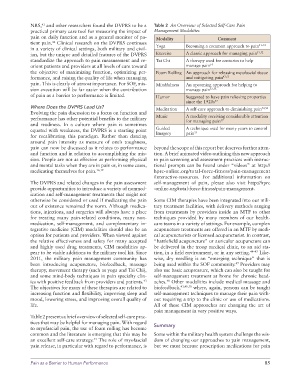
              Table 2 presents a brief overview of selected self-care prac-
              tices that may be helpful for managing pain. With regard   Summary
              to myofascial pain, the use of foam rolling has become
              common and the literature is emerging that this may be   Some within the military health system challenge the wis-
              an excellent self-care strategy.  The role of myofascial   dom of changing our approaches to pain management,
                                        44
              pain release, in particular with regard to performance, is   but we must because prescription medications for pain


              Pain as a Barrier to Human Performance                                                          85

