


Page 98 - Journal of Special Operations Medicine - Summer 2016
P. 98
with patients. In addition, the use of zero, mild, mod-  conditions as well as how they measure what constitutes
          erate, and severe pain levels corresponding to the pain   successful pain management.
          intensity colors and bars was included to conform to
          the 4-point pain scale used by the United Kingdom and   Importantly, the DVPRS incorporates four supplemen-
          other North Atlantic Treaty Organization (NATO) mili-  tal questions with numeric ratings (0–10) that allow a
          tary partners. 37                                  patient to identify how much his/her pain interferes with
                                                             physical activity and sleep and how it affects mood and
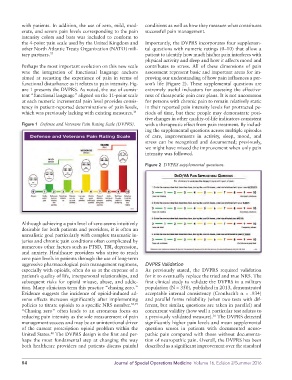
          Perhaps the most important evolution on this new scale   contributes to stress. All of these dimensions of pain
          was the integration of functional language anchors   assessment represent basic and important areas for im-
          aimed at  recasting the  experience of  pain in terms  of   proving our understanding of how pain influences a per-
          functional disturbance as it relates to pain intensity. Fig-  son’s life (Figure 2). These supplemental questions are
          ure 1 presents the DVPRS. As noted, the use of consis-  extremely useful indicators for assessing the effective-
          tent “functional language” aligned on the 11-point scale   ness of therapeutic pain care plans. It is not uncommon
          at each numeric incremental pain level provides consis-  for persons with chronic pain to remain relatively static
          tency in patient-reported determinations of pain levels,   in their reported pain intensity levels for protracted pe-
          which was previously lacking with existing measures. 36  riods of time, but these people may demonstrate posi-
                                                             tive changes in other quality-of-life indicators consistent
          Figure 1  Defense and Veterans Pain Rating Scale (DVPRS).  with a therapeutic effect from pain treatment. By includ-
                                                             ing the supplemental questions across multiple episodes
                                                             of care, improvements in activity, sleep, mood, and
                                                             stress  can  be  recognized  and documented;  previously,
                                                             we might have missed the improvement when only pain
                                                             intensity was followed.

                                                             Figure 2  DVPRS supplemental questions.


          Although achieving a pain level of zero seems intuitively
          desirable for both patients and providers, it is often an
          unrealistic goal particularly with complex traumatic in-
          juries and chronic pain conditions often complicated by
          numerous other factors such as PTSD, TBI, depression,
          and anxiety. Healthcare providers who strive to reach
          zero pain levels in patients through the use of long-term
          aggressive pharmacological pain management regimens,   DVPRS Validation
          especially with opioids, often do so at the expense of a   As previously stated, the DVPRS required validation
          patient’s quality of life, interpersonal relationships, and   for it to eventually replace the tried and true NRS. The
          subsequent risks for opioid misuse, abuse, and addic-  first clinical study to validate the DVPRS in a military
          tion. Many clinicians term this practice “chasing zero.”   population (N = 350), published in 2013, demonstrated
          Evidence suggests the incidence of opioid-induced ad-  acceptable  internal  consistency  (Cronbach’s  α =  .934)
          verse  effects  increases  significantly  after  implementing   and parallel forms reliability (when two tests with dif-
          policies to titrate opioids to a specific NRS number. 38,39   ferent, but similar, questions are taken in parallel) and
          “Chasing zero” often leads to an erroneous focus on   concurrent validity (how well a particular test relates to
          reducing pain intensity as the sole measurement of pain   a previously validated measure).  The DVPRS detected
                                                                                         36
          management success and may be an unintentional driver   significantly higher pain levels and mean supplemental
          of the current prescription opioid problem within the   question scores in patients with documented neuro-
          United States.  The DVPRS design is the first and per-  pathic pain compared with those without documenta-
                      40
          haps  the  most  fundamental  step  at  changing the  way   tion of neuropathic pain. Overall, the DVPRS has been
          both healthcare providers and patients discuss painful   described as a significant improvement over the  standard


          84                                    Journal of Special Operations Medicine  Volume 16, Edition 2/Summer 2016

