


Page 97 - Journal of Special Operations Medicine - Summer 2016
P. 97
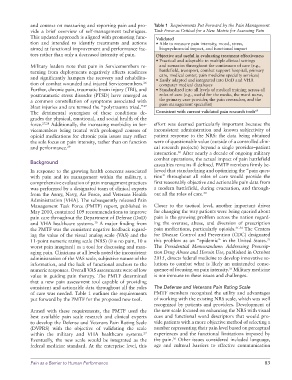
and context on measuring and reporting pain and pro-  Table 1  Requirements Put Forward by the Pain Management
              vide a brief overview of self-management techniques.   Task Force as Critical for a New Metric for Assessing Pain
              This updated approach is aligned with promoting func-  Validated
              tion and intended to identify treatments and actions   •  Able to measure pain intensity, mood, stress,
              aimed at functional improvement and performance fac-  biopsychosocial impact, and functional impact
              tors rather than only a decreased intensity of pain.  Objective and useful in evaluating treatment effectiveness
                                                                 •  Practical and adaptable to multiple clinical settings
              Military leaders note that pain in Servicemembers re-  and scenarios throughout the continuum of care (e.g.,
              turning from deployments negatively affects readiness   battlefield, transport, combat support hospital, primary
                                                                   care, medical center, pain medicine specialty services)
              and significantly hampers the recovery and rehabilita-  •  Easily adapted and integrated into DoD and VHA
              tion of combat wounded and injured Servicemembers.    computer medical databases
                                                            26
              Further, chronic pain, traumatic brain injury (TBI), and   •  Standardized into all levels of medical training across all
              posttraumatic stress disorder (PTSD) have emerged as   roles of care (e.g., useful for the medic, the ward nurse,
              a  common  constellation  of  symptoms  associated  with   the primary care provider, the pain researcher, and the
                                                                   pain management specialist)
              blast injuries and are termed the “polytrauma triad.”
                                                            27
              The detrimental synergism of these conditions de-  Consistent with current validated pain research tools 13
              grades the physical, emotional, and social health of the
              force. 27,28  Additionally, the increasing morbidity in Ser-  effort was deemed particularly important because the
              vicemembers being treated with prolonged courses of   inconsistent administration and known subjectivity of
              opioid medications for chronic pain issues may reflect   patient response to the NRS: the data being obtained
              the sole focus on pain intensity, rather than on function   were of questionable value (outside of a controlled clini-
              and performance. 29                                cal research projects) beyond a single provider–patient
                                                                 interaction.  After nearly a decade of ongoing military
                                                                          30
                                                                 combat operations, the actual impact of pain battlefield
              Background                                         casualties remains ill defined. PMTF members firmly be-
              In response to the growing health concerns associated   lieved that standardizing and optimizing the “pain ques-
              with pain and its management within the military, a   tion”  throughout  all  roles  of  care  would  provide  the
              comprehensive evaluation of pain management practices   first reasonably objective and actionable pain data from
              was performed by a designated team of clinical experts   a modern battlefield, during evacuation, and through-
              from the Army, Navy, Air Force, and Veterans Health   out all the roles of care. 30
              Administration (VHA). The subsequently released Pain
              Management Task Force (PMTF) report, published in   Closer to the tactical level, another important driver
              May 2010, contained 109 recommendations to improve   for changing the way patients were being queried about
              pain care throughout the Department of Defense (DoD)   pain is the growing problem across the nation regard-
              and  VHA healthcare  systems.   A major  finding from   ing the overuse, abuse, and diversion of prescription
                                        30
              the PMTF was the consistent negative feedback regard-  pain medications, particularly opioids. 31-34  The Centers
              ing the value of the visual analog scale (VAS) and the   for Disease Control and Prevention (CDC) designated
              11-point numeric rating scale (NRS) (0 = no pain, 10 =   this problem as an “epidemic” in the United States.
                                                                                                               31
              worst pain imagined) as a tool for discussing and man-  The  Presidential Memorandum: Addressing Prescrip-
              aging pain. Clinicians at all levels noted the inconsistent   tion Drug Abuse and Heroin Use, published in October
              administration of the VAS scale, subjective nature of the   2015, directs federal medicine to develop innovative so-
              information, and the lack of functional anchors to the   lutions to combat what is likely an unintended conse-
              numeric responses. Overall VAS assessments were of low   quence of focusing on pain intensity.  Military medicine
                                                                                                35
              value in guiding pain therapy. The PMTF determined   is not immune to these issues and challenges.
              that a new pain assessment tool capable of providing
              consistent and actionable data throughout all the roles   The Defense and Veterans Pain Rating Scale
              of care was needed. Table 1 outlines the requirements   PMTF members recognized the utility and advantages
              put forward by the PMTF for the proposed new tool.  of working with the existing NRS scale, which was well
                                                                 recognized by patients and providers. Development of
              Armed with these requirements, the PMTF used the   the new scale focused on enhancing the NRS with visual
              best available pain scale research and clinical experts   cues and functional word descriptors that would pro-
              to develop the Defense and Veterans Pain Rating Scale   vide patients with a more objective method of selecting a
              (DVPRS) with the objective of validating the scale   number representing their pain level based on perceptual
              within the military and VHA healthcare systems.    experiences and the functional limitations imposed by
                                                            27
              Eventually, the new scale would be integrated as the   the pain.  Other issues considered included language,
                                                                        36
              federal medicine standard. At the enterprise level, this   age and cultural barriers to effective   communication


              Pain as a Barrier to Human Performance                                                          83

