


Page 104 - Journal of Special Operations Medicine - Summer 2016
P. 104
( Valneva, http://www.valneva.com), which was approved   Disclaimer
          for use in adults in 2009 and in children in 2013. It is a   The views expressed in this publication are those of the
          two-vaccine series with at least 28 days between admin-  author and do not reflect the official policy or position
          istration; the second ideally given at least a week before   of the Department of the Army, Department of Defense,
          any potential exposure. The Advisory Committee on   or the US Government.
          Immunization Practices has recommended that travelers
          who are staying more than a month in areas endemic
          for JE be vaccinated. They also recommend that trav-  Disclosure
          elers who plan to spend less than a month in endemic   The author has nothing to disclose.
          areas but whose activities are considered “higher risk”
          for exposure (e.g., extensive outdoor activities, camp-
          ing, hiking) also be vaccinated. For adult patients, if the   Bibliography
          IXIARO series was given more than a year earlier and   Japanese encephalitis vaccines: WHO position paper—February
          re-exposure is expected, a booster dose is recommended.  2015. Wkly Epidemiol Rec. 2015;90:69–87.
                                                             Centers for Disease Control and Prevention.  Chapter 3: Infec-
          Studies have been performed to see if those who previ-  tious diseases related to travel: Japanese encephalitis. http://
          ously received the mouse-brain–derived JE-Vax, which   www .nc.cdc.gov/travel/yellowbook/2016/infectious-diseases
                                                                 -related-to-travel/japanese-encephalitis
          was widely used in the US military but is now not avail-  Deshpande BR, Rao SR, Jentes ES, et al. Use of Japanese en-
          able, can obtain adequate protection from a single IXI-  cephalitis vaccine in US travel medicine practices in global
          ARO  “booster dose.”  The results  of  these studies  are   TraveEpiNet. Am J Trop Med Hyg. 2014;91:694–698.
          preliminary, so the current recommendation is that any-
          one who previously received the JE-Vax series should re-  Recommended Internet Links
          ceive the two-dose primary series of the IXIARO vaccine.
                                                             http://www.cdc.gov/japaneseencephalitis/index.html
                                                             http://www.who.int/immunization/diseases/japanese
          Importance in a Deployed Setting
                                                             _encephalitis/en/
          JE is a risk to military forces deployed to large areas of
          Asia and the Western Pacific. Those at highest risk are
          Servicemembers deployed to rural areas where the dis-
          ease is endemic, especially during the summer and fall   COL Burnett is currently Chief of Pediatric Infectious Dis-
          in temperate areas, and during the monsoon season in   eases at Tripler Army Medical Center in Hawaii, and is the
          semitropical and tropical regions. Wearing permethrin-  Pediatric Subspecialties Consultant to the US Army Surgeon
          treated uniforms and using DEET (N,N-diethyl-meta-  General. He is board certified in Pediatrics and Pediatric In-
          toluamide)-containing insect repellents, coupled with   fectious Diseases. He has served overseas in Korea, Germany,
          appropriate vaccination, is key to the prevention of this   Kosovo, Iraq, Afghanistan, Kuwait, and as the JSOTF-P Sur-
                                                             geon in the Philippines. He is a graduate of the University of
          potentially catastrophic disease.                  Wisconsin-Madison, and the Medical College of Wisconsin.
                                                             E-mail: mark.w.burnett.mil@mail.mil.

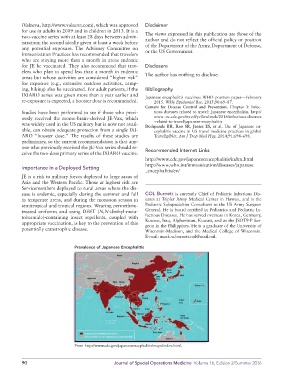
                                Prevalence of Japanese Encephalitis


                                From http://www.cdc.gov/japaneseencephalitis/maps/index.html.


          90                                    Journal of Special Operations Medicine  Volume 16, Edition 2/Summer 2016

