


Page 108 - Journal of Special Operations Medicine - Summer 2016
P. 108
would otherwise require notable distances to be cov-  Disclaimer
          ered by trainees on foot. Similar consideration should   The views expressed in this presentation are those of the
          be given to limiting activities that could impact on the   authors and do not necessarily reflect the official policy
          trainee’s nutritional intake (e.g., limited time to eat in   of the Department of Defense, Department of the Army,
          the mess hall due to competing interests like time to   US Army Medical Department, or the US government.
          get to and from classes, change uniforms, return stores,   The use of trademark names does not imply endorse-
          etc.) or disrupt or reduce effective sleep (e.g., late night   ment by the US Army but is intended only to assist in the
          or very early in the morning operations training) and   identification of a specific product.
          the impacts that these activities could have on trainee
          recovery and training performance over the following
          days, except on occasions where sleep disruption is used   Disclosures
          deliberately and safely as a training tool.
                                                             The authors have nothing to disclose.
          A final consideration is the need to consider factors
          unique to the trainee program, like the venue, the train-  References
          ing intent and the profile of the trainees attending. One
          means of determining these factors is through the use     1.  Shwayhat AF, Linenger JM, Hofherr LK, et al. Profiles of ex-
          of a dedicated risk assessment encompassing the overall   ercise history and overuse injuries among United States Navy
          trainee program. Frameworks like Haddon’s Matrix      Sea, Air, and Land (SEAL) recruits. Am J Sports Med. 1994;22:
                                                         29
                                                                835–840.
          can be useful in this process and have been shown to     2.  Kaufman KR, Brodine S, Shaffer R. Military training-related
          have success in enabling systematic risk mitigation.   injuries: surveillance, research, and prevention.  Am J Prev
          Other such resources include the possibly more familiar   Med. 2000;18:54–63.
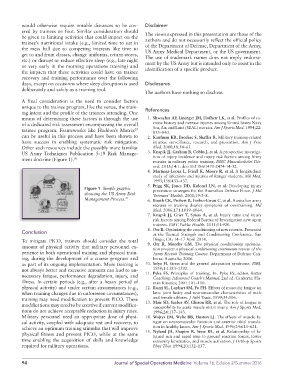
          US Army Techniques Publication 5-19 Risk Manage-     3.  Knapik JJ, Graham B, Cobbs J, et al. A prospective investiga-
          ment doctrine (Figure 1). 30                          tion of injury incidence and injury risk factors among Army
                                                                recruits in military police training. BMC Musculoskelet Dis-
                                                                ord. 2013;14:1. doi:10.1186/1471-2474-14-32.
                                                               4.  Martinez-Lopez L, Friedl K, Moore R, et al. A longitudinal
                                                                study of infections and injuries of Ranger students. Mil Med.
                                                                1993;158:433–437.
                                                               5.  Prigg SK, Jones DD, Kolonel LN, et al.  Developing injury
                                    Figure 1  Simple graphic    prevention strategies for the Australian Defence Force. J Mil
                                    showing the US Army Risk    Veterans’ Health. 2000;19:3–8.
                                    Management Process. 31     6.  Booth CK, Probert B, Forbes-Ewan C, et al. Australian army
                                                                recruits  in  training  display  symptoms  of  overtraining.  Mil
                                                                Med. 2006;171:1059–1064.
                                                               7.  Knapik JJ, Grier T, Spiess A, et al.  Injury rates and injury
                                                                risk factors among Federal Bureau of Investigation new agent
                                                                trainees. BMC Public Health. 2011;11:920.
          Conclusion                                           8.  Orr R. Optimizing the conditioning of new recruits. Presented
                                                                at the Tactical Strength and Conditioning Conference. San
          To mitigate PICO, trainers should consider the total   Diego, CA: 14–17 April 2014.
          amount of physical activity that military personnel ex-    9.  Orr R, Moorby GM.  The physical conditioning optimisa-
                                                                tion project: a physical conditioning continuum review of the
          perience in both operational training and physical train-  Army Recruit Training Course. Department of Defence Can-
          ing, during the development of a course program and   berra: Australia; 2006.
          as part of its ongoing implementation. More training is   10.  Selye H. Stress and the general adaptation syndrome. BMJ.
          not always better and excessive amounts can lead to un-  1950;1:1383–1392.
          necessary fatigue, performance degradation, injury, and   11.  Pyke FS. Principles of training. In: Pyke FS, editor.  Better
                                                                Coaching: Advanced Coach’s Manual. 2nd ed. Canberra: Hu-
          illness. In certain periods (e.g., after a heavy period of   man Kinetics; 2001:101–110.
          physical activity) and under certain circumstances (e.g.,   12.  Rozzi SL, Lephart SM, Fu FH. Effects of muscular fatigue on
          when training changes due to unforeseen circumstances),   knee joint laxity and neuromuscular characteristics of male
          training may need modification to prevent PICO. These   and female athletes. J Athl Train. 1999;34:106.
          modifications may need to be creative if current modifica-  13.  Mair SD, Seaber AV, Glisson RR, et al. The role of fatigue in
                                                                susceptibility to acute muscle strain injury. Am J Sports Med.
          tions do not achieve acceptable reduction in injury rates.   1996;24:137–143.
          Military  personnel  need  an  appropriate  dose  of  physi-  14.  Wojtys EM, Wylie BB, Huston LJ. The effects of muscle fa-
          cal activity, coupled with adequate rest and recovery, to   tigue on neuromuscular function and anterior tibial transla-
          achieve an optimum training stimulus that will improve   tion in healthy knees. Am J Sports Med. 1996;24:615–621.
          physical fitness and prevent PICO, while at the same   15.  Nyland JA, Shapiro R, Stine RL, et al.  Relationship of fa-
                                                                tigued run and rapid stop to ground reaction forces, lower
          time enabling the acquisition of skills and knowledge   extremity kinematics, and muscle activation. J Orthop Sports
          required for military operations.                     Phys Ther. 1994;20:132–137.


          94                                    Journal of Special Operations Medicine  Volume 16, Edition 2/Summer 2016

