


Page 111 - Journal of Special Operations Medicine - Summer 2016
P. 111
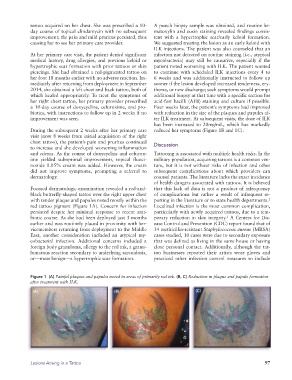
tattoo acquired on her chest. She was prescribed a 10-  A punch biopsy sample was obtained, and routine he-
              day course of topical clindamycin with no subsequent   matoxylin and eosin staining revealed findings consis-
              improvement; the pain and mild pruritus persisted, thus   tent with a hypertrophic scar/early keloid formation.
              causing her to see her primary care provider.      We suggested treating the lesion as an early keloid with
                                                                 ILK injections. The patient was also counseled that an
              At her primary care visit, the patient denied significant   infection not detected on routine staining (i.e., atypical
              medical history, drug allergies, and previous keloid or   mycobacteria) may still be causative, especially if the
              hypertrophic scar formation with prior tattoos or skin   patient noted worsening with ILK. The patient wanted
              piercings. She had obtained a red-pigmented tattoo on   to continue with scheduled ILK injections every 4 to
              her foot 18 months earlier with no adverse reaction. Im-  6 weeks and was additionally instructed to follow up
              mediately after returning from deployment in September   sooner if the lesion developed increased tenderness, ery-
              2014, she obtained a left chest and back tattoo, both of   thema, or new discharge; such symptoms would prompt
              which healed appropriately. To treat the symptoms of   additional biopsy at that time with a specific section for
              her right chest tattoo, her primary provider prescribed   acid-fast bacilli (AFB) staining and culture if possible.
              a 10-day course of doxycycline, cefuroxime, and pro-  Four weeks later, the patient’s symptoms had improved
              biotics, with instructions to follow up in 2 weeks if no   with reduction in the size of the plaques and papules af-
              improvement was seen.                              ter ILK treatment. At subsequent visits, the dose of ILK
                                                                 has  been  increased  to  20mg/mL,  which  has  markedly
              During the subsequent 2 weeks after her primary care   reduced her symptoms (Figure 1B and 1C).
              visit (now 8 weeks from initial acquisition of the right
              chest tattoo), the patient’s pain and pruritus continued   Discussion
              to increase and she developed worsening inflammation
              and edema. As the course of doxycycline and cefurox-  Tattooing is associated with multiple health risks. In the
              ime yielded suboptimal improvement, topical fluoci-  military population, acquiring tattoos is a common ven-
              nonide 0.05% cream was added. However, the cream   ture, but it is not without risks of infection and other
              did not improve symptoms, prompting a referral to   subsequent complications about which providers can
              dermatology.                                       counsel patients. The literature lacks the exact incidence
                                                                 of health dangers associated with tattoos. It is believed
              Focused dermatologic examination revealed a red-and-  that this lack of data is not a product of infrequency
              black butterfly-shaped tattoo over the right upper chest   of complications but rather a result of infrequent re-
              with tender plaque and papules noted mostly within the   porting in the literature or to state health departments.
                                                                                                                2
              red tattoo pigment (Figure 1A). Concern for infection   Localized infection is the most common complication,
              persisted despite her minimal response to recent anti-  particularly with newly acquired tattoos, due to a tem-
              biotic course. As she had been deployed just 3 months   porary reduction in skin integrity.  A Centers for Dis-
                                                                                               3
              earlier and was routinely placed in proximity with Ser-  ease Control and Prevention (CDC) report found that of
              vicemembers returning from deployment to the Middle   34 methicillin-resistant Staphylococcus aureus (MRSA)
              East, another consideration included an atypical my-  cases studied, 10 cases were due to secondary exposure
              cobacterial infection. Additional concerns included a   that was defined as living in the same house or having
              foreign body granuloma, allergy to the red ink, a granu-  close personal contact. Additionally, although the tat-
              lomatous reaction secondary to underlying sarcoidosis,   too businesses  reported their artists  wore gloves and
              or—most benign—a hypertrophic scar formation.      practiced other infection control measures to include


              Figure 1  (A) Painful plaques and papules noted in areas of primarily red ink. (B, C) Reduction in plaque and papule formation
              after treatment with ILK.
               (A)                              (B)                               (C)


              Lesions Arising in a Tattoo                                                                     97

