


Page 47 - Journal of Special Operations Medicine - Summer 2016
P. 47
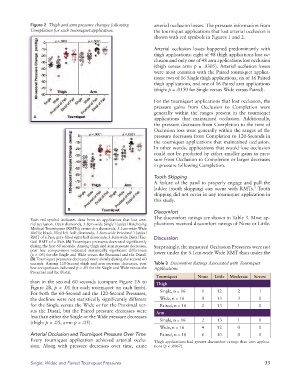
Figure 2  Thigh and arm pressure changes following     arterial occlusion losses. The pressure information from
              Completion for each tourniquet application.        the tourniquet applications that lost arterial occlusion is
                                                                 shown with red symbols in Figures 1 and 2.

                                                                 Arterial occlusion losses happened predominantly with
                                                                 thigh applications: eight of 48 thigh applications lost oc-
                                                                 clusion and only one of 48 arm applications lost occlusion
                                                                 (thigh versus arm:  p = .0305). Arterial occlusion losses
                                                                 were most common with the Paired tourniquet applica-
                                                                 tions: two of 16 Single thigh applications, six of 16 Paired
                                                                 thigh applications, and one of 16 Paired arm applications
                                                                 (thigh: p = .0150 for Single versus Wide versus Paired).

                                                                 For the tourniquet applications that lost occlusion, the
                                                                 pressure gains from Occlusion to Completion were
                                                                 generally within the ranges present in the tourniquet
               A                                                 applications  that  maintained  occlusion.  Additionally,
                                                                 the pressure decreases from Completion to the time of
                                                                 Occlusion loss were generally within the ranges of the
                                                                 pressure decreases from Completion to 120-Seconds in
                                                                 the tourniquet applications that maintained occlusion.
                                                                 In other words, applications that would lose occlusion
                                                                 could not be predicted by either smaller gains in pres-
                                                                 sure from Occlusion to Completion or larger decreases
                                                                 in pressure following Completion.

                                                                 Tooth Skipping
                                                                 A failure of the pawl to properly engage and pull the
                                                                 ladder (tooth skipping) can occur with RMTs.  Tooth
                                                                                                          5
                                                                 skipping did not occur in any tourniquet application in
                                                                 this study.
                             B
                                                                 Discomfort
                                                                 The discomfort ratings are shown in Table 3. Most ap-
              Each red symbol indicates data from an application that lost arte-
              rial occlusion. Open diamonds, 3.8cm-wide Single Tactical Ratcheting   plications received discomfort ratings of None or Little.
              Medical Tourniquets (RMTs); center dot diamonds, 5.1cm-wide Wide
              RMTs; black-filled left half diamonds, 3.8cm-wide Proximal Tactical
              RMT of a Pair; gray-filled right half diamonds, 3.8cm-wide Distal Tac-  Discussion
              tical RMT of a Pair. (A) Tourniquet pressures decreased significantly
              during the first 60 seconds. Among thigh and arm pressure decreases,   Surprisingly, the measured Occlusion Pressures were not
              post hoc comparisons indicated statistically significant differences    lower under the 5.1cm-wide Wide RMT than under the
              (p < .05) for the Single and Wide versus the Proximal and the Distal.
              (B) Tourniquet pressures decreased more slowly during the second 60
              seconds. Among 120-Second thigh and arm pressure decreases, post   Table 3  Discomfort Ratings Associated with Tourniquet
              hoc comparisons indicated p < .05 for the Single and Wide versus the   Applications
              Proximal and the Distal.
                                                                 Tourniquet        None   Little  Moderate  Severe
              than in the second 60 seconds (compare Figure 2A to   Thigh
              Figure 2B, p < .01 for each tourniquet on each limb).
              For both the 60-Second and the 120-Second Pressures,   Single, n = 16  1     12      2        1
              the declines were not statistically significantly different   Wide, n = 16  0  13    3        0
              for the Single versus the Wide or for the Proximal ver-  Paired, n = 16  2   13      1        0
              sus the Distal, but the Paired pressure decreases were   Arm
              less than either the Single or the Wide pressure decreases
              (thigh: p < .05, arm: p < .05).                      Single, n = 16   2      13      1        0
                                                                   Wide, n = 16     4      12      0        0
              Arterial Occlusion and Tourniquet Pressure Over Time  Paired, n = 16  6      10      0        0
              Every tourniquet application achieved arterial occlu-  Thigh applications had greater discomfort ratings than arm applica-
              sion. Along with pressure decreases over time, came   tions (p < .0067).


              Single, Wider, and Paired Tourniquet Pressures                                                  33

