


Page 45 - Journal of Special Operations Medicine - Summer 2016
P. 45
the pull to Friction Pressure). Additionally, arm appli-  of the Single and Wide tourniquets were not statistically
              cations on the three women with the smallest circum-  significantly different from each other and were higher
              ference arms required movement of the Strap cuff 2cm   than the Occlusion Pressures of each of the Paired tour-
              closer to the ladder attachment to avoid pulling the in-  niquets. On the arm, only the Proximal of the Pair had
              flated bladder into the friction buckle. Strap pressures in   statistically significantly lower Occlusion Pressures than
              these applications are, therefore, not comparable to the   the others.
              other Strap pressures.
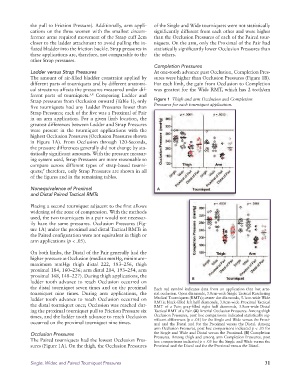
                                                                 Completion Pressures
              Ladder versus Strap Pressures                      At one-tooth advance past Occlusion, Completion Pres-
              The amount of air-filled bladder constraint applied by   sures were higher than Occlusion Pressures (Figure 1B).
              different parts of tourniquets and by different anatomi-  For each limb, the gain from Occlusion to Completion
              cal structures affects the pressures measured under dif-  was greatest for the Wide RMT, which has 2 teeth/cm
              ferent parts of tourniquets.  Comparing Ladder and
                                      5,8
              Strap pressures from Occlusion onward (Table 1), only   Figure 1  Thigh and arm Occlusion and Completion
              five tourniquets had any Ladder Pressures lower than   Pressures for each tourniquet application.
              Strap Pressures; each of the five was a Proximal of Pair
              in an arm application. For a given limb location, the
              greatest differences between Ladder and Strap Pressures
              were  present  in  the  tourniquet  applications  with  the
              highest Occlusion Pressures (Occlusion Pressures shown
              in Figure 1A). From Occlusion through 120- Seconds,
              the pressure differences generally did not change by sta-
              tistically significant amounts. With the pressure measur-
              ing system used, Strap Pressures are more reasonable to
              compare  across  different  types  of strap-based  tourni-
              quets;  therefore, only Strap Pressures are shown in all
                   7
              of the figures and in the remaining tables.

              Nonequivalence of Proximal                          A
              and Distal Paired Tactical RMTs

              Placing a second tourniquet adjacent to the first allows
              widening of the zone of compression. With the methods
              used, the two tourniquets in a pair would not necessar-
              ily have the same pressures. Occlusion Pressures (Fig-
              ure 1A) under the proximal and distal Tactical RMTs in
              the Paired configuration were not equivalent in thigh or
              arm applications (p < .05).

              On both limbs, the Distal of the Pair generally had the
              higher pressure at Occlusion (median mmHg, minimum–
              maximum mmHg: thigh distal 222, 183–256, thigh
              proximal 184, 160–236; arm distal 204, 193–254, arm
              proximal 168, 148–227). During thigh applications, the            B
              ladder tooth advance to reach Occlusion occurred on
              the distal tourniquet seven times and on the proximal   Each red symbol indicates data from an application that lost arte-
              tourniquet nine times. During arm applications, the   rial occlusion. Open diamonds, 3.8cm-wide Single Tactical Ratcheting
                ladder tooth advance to reach Occlusion occurred on   Medical Tourniquets (RMTs); center dot diamonds, 5.1cm-wide Wide
                                                                 RMTs; black-filled left half diamonds, 3.8cm-wide Proximal Tactical
              the distal tourniquet once; Occlusion was reached dur-  RMT of a Pair; gray-filled right half diamonds, 3.8cm-wide Distal
              ing the proximal tourniquet pull to Friction Pressure six   Tactical RMT of a Pair. (A) Arterial Occlusion Pressures. Among thigh
              times, and the ladder tooth advance to reach Occlusion   Occlusion Pressures, post hoc comparisons indicated statistically sig-
                                                                 nificant differences (p < .05) for the Single and Wide versus the Proxi-
              occurred on the proximal tourniquet nine times.    mal and the Distal and for the Proximal versus the Distal. Among
                                                                 arm Occlusion Pressures, post hoc comparisons indicated p < .05 for
              Occlusion Pressures                                the Single and Wide and Distal versus the Proximal. (B) Completion
                                                                 Pressures. Among thigh and among arm Completion Pressures, post
              The Paired tourniquets had the lowest Occlusion Pres-  hoc comparisons indicated p < .05 for the Single and Wide versus the
              sures (Figure 1A). On the thigh, the Occlusion Pressures   Proximal and the Distal and for the Proximal versus the Distal.


              Single, Wider, and Paired Tourniquet Pressures                                                  31

