


Page 122 - Journal of Special Operations Medicine - Summer 2016
P. 122
An Ongoing Series


                                 “SWAT Is a Lifestyle; It’s a Way of Life”
                                  Ray Casillas on a Career in Operational Medicine


                                        Interviewed by John F. Kragh Jr, MD


          Tell us a little about yourself.                   (USC) Sol Price School of Public Policy, Safe Communi-
          I thank the  Journal of Special Operations Medicine for   ties Institute program (SCI) (http://priceschool.usc.edu/
          this opportunity. I credit the folks that have trained and   programs/sci/) and will attend their Executive Program in
          mentored me: The Los Angeles County Sheriff’s Depart-  Counter Terrorism, Center for Risk and Economic Analy-
                          ment  Special  Enforcement Bureau   sis of Terrorism Events (CREATE) over the summer (http://
                          (LASD SEB), Huntington Beach SWAT   create.usc.edu/).  I  have  worked  behind  the  scenes  for
                          [Special Weapons and Tactics], Hun-  many years on TEMS and assisted with various projects.
                          tington Beach FD [Fire Department],   But only within the past few years, because I was asked,
                          Phil Carmona (retired Special Opera-  have I begun to take on a leadership role.
                          tions Forces [SOF]), Mike Meoli (re-
                          tired Sea, Air, and Land [SEAL]), Dr   The SWAT team you work on, is it a full-time team or
                          Andy Pennardt (COL, Ret.), Dr Mark   part-time team? How does it work?
          Ray Casilllas   Cannon, Dave Rathbun (retired LASD   Team members are collaterally assigned to SWAT, mean-
                          SEB), Professor                                      ing that our primary assignments are
          Frank Quiambao, and, of course,                                      other  than-SWAT. As  for  the  med-
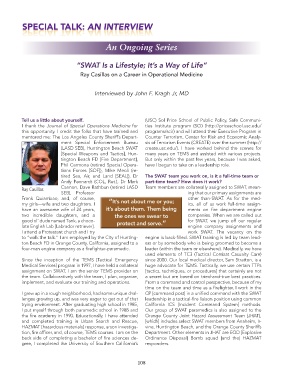
          my girls—wife and two daughters. I   “It’s not about me or you;      ics,  all  of  us work  full-time  assign-
          have an awesome wife of 24 years,   it’s about them. Them being      ments on fire department engine
          two incredible daughters, and a       the ones we swear to           companies. When we are called out
          good ol’ dude named Tank, a choco-                                   for SWAT, we jump off our regular
          late English Lab [Labrador retriever].   protect and serve.”         engine company assignments and
          I attend a Protestant church and I try                               work  SWAT. The vacancy  on  the
          to “walk the talk.” I am employed by the City of Hunting-  engine is back-filled. SWAT training is led by team lead-
          ton Beach FD in Orange County, California, assigned to a   ers or by somebody who is being groomed to become a
          four-man engine company as a firefighter-paramedic.  leader (within the team or elsewhere). Medically, we have
                                                             used elements of TC3 (Tactical Combat Casualty Care)
          Since the inception of the TEMS [Tactical Emergency   since 2000. Our local medical director, Sam Stratton, is a
          Medical Services] program in 1997, I have held a collateral   huge advocate for TEMS. Tactically, we use certain TTPs
          assignment on SWAT. I am the senior TEMS provider on   [tactics, techniques, or procedures] that certainly are not
          the team. Collaboratively with the team, I plan, organize,   a secret but are based on tried-and-true best practices.
          implement, and evaluate our training and operations.  From a command and control perspective, because of my
                                                             time on the team and time as a firefighter, I work in the
          I grew up in a rough neighborhood, had some unique chal-  CP [command post] in a unified command with the SWAT
          lenges growing up, and was very eager to get out of that   leadership in a tactical-fire liaison position using common
          trying environment. After graduating high school in 1985,   California  ICS  [Incident  Command  System]  methods.
          I put myself through both paramedic school in 1988 and   Our group of SWAT paramedics is also assigned to the
          the fire academy in 1990. Educationally, I have attended   Orange County Joint Hazard Assessment Team (JHAT),
          and  completed training in Urban Search and Rescue,   [which] includes select SWAT members from Anaheim, Ir-
          HAZMAT [hazardous materials] response, arson investiga-  vine, Huntington Beach, and the Orange County Sheriff’s
          tion, fire officer, and, of course, TEMS courses. I am on the   Department. Other elements in JHAT are EOD [Explosive
          back side of completing a bachelor of fire sciences de-  Ordinance Disposal] Bomb squad [and the] HAZMAT
          gree, I completed the University of Southern  California’s   responders.


                                                          108

