


Page 126 - Journal of Special Operations Medicine - Summer 2016
P. 126
Nigerien CASEVAC program in relation to the RAND   with validation and PN program sustainment. Although
          corporation’s report on best practice GHE recommen-  the outline recognizes a 2-year timeline, the overall pace
          dations.  This also included a detailed breakdown of   and progression to each phase is dependent on the PN
                 3
          the cost effectiveness of these programs. Both articles   and should not be limited to a specific schedule.
          provide outstanding in-depth, technical outlines of the
          SOCAFR model along with best practice recommenda-  Final Phase Implementation (Sustainable Model)
          tions for both operational commanders and medical
          personnel. (The reader is highly encouraged to reference   The final phase implementation of the Niger CASEVAC
          both articles to better understand the history of this   program was successfully executed in 2015. This in-
          program). However, neither article outlined the final   cluded three separate AFSOAWC missions to assist key
          key phases of the program and overall lessons learned.   Nigerien CASEVAC instructors on CASEVAC course
          These are discussed in this article.               and curriculum development (Figure 2) in addition to
                                                             overall program validation. Important aspects focused
          Over the past 2 years, the operational execution of this   on instructor development and empowerment, which
          ongoing mission has been led by the Air Force Spe-  included “mock” courses for the instructors (Figure 3).
          cial Operations Air Warfare Center (AFSOAWC) IW    This provided an environment to facilitate construc-
          Medical Operations Division. The division (which we   tive feedback and recommendations for improvement,
          fall under) remains an Air Force Special Operations   which was extremely well received prior to the instruc-
          Command (AFSOC) focal point for GHE/IHS and IW/    tors’ CASEVAC course.
          Aviation Foreign Internal Defense (AvFID) medical sup-
          port. We provide language-trained operational medi-
          cal advisors to assess, train, advise, and assist foreign
          aviation and medical forces in battlefield medicine and
            CASEVAC principles. Our goal is to build sustainable                     Figure 2  CASEVAC
          PN capacity through strategic GHE activities. The Ni-                      instructor manual (provided
          gerien  CASEVAC program has provided an incredible                         by Capt Nicole Graves).
          opportunity to learn and improve our current processes
          within these areas.

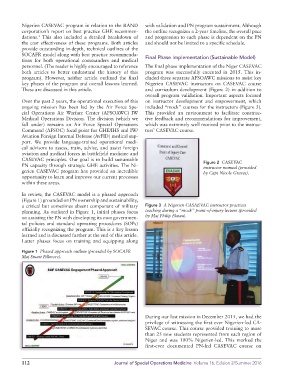
          In review, the CASEVAC model is a phased approach
          (Figure 1) grounded on PN ownership and sustainability,
          a critical but sometimes absent component of military   Figure 3  A Nigerien CASAEVAC instructor practices
          planning. As outlined in Figure 1, initial phases focus   teaching during a “mock” point-of-injury lecture (provided
          on assisting the PN with developing its own governmen-  by Maj Philip Flatau).
          tal policies and standard operating procedures (SOPs)
          officially recognizing the program. This is a key lesson
          learned and is discussed further at the end of this article.
          Latter phases focus on training and equipping along

          Figure 1  Phased approach outline (provided by SOCAFR
          Maj Stuart Fillmore).


                                                             During our last mission in December 2015, we had the
                                                             privilege of witnessing the first ever Nigerien-led CA-
                                                             SEVAC course. This course provided training to more
                                                             than 25 new students represented from each region of
                                                             Niger and was 100% Nigerien-led. This marked the
                                                             first-ever documented PN-led CASEVAC course on


          112                                   Journal of Special Operations Medicine  Volume 16, Edition 2/Summer 2016

