


Page 117 - Journal of Special Operations Medicine - Summer 2016
P. 117
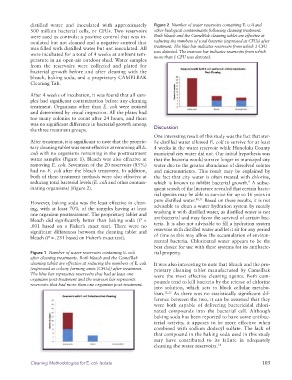
distilled water and inoculated with approximately   Figure 2  Number of water reservoirs containing E. coli and
              500 million bacterial cells, or CFUs. Two reservoirs   other biological contaminants following cleaning treatment.
              were used as controls: a positive control that was in-  Both bleach and the CamelBak cleaning tablet are effective at
              oculated but not cleaned and a negative control that   reducing the numbers of total bacteria (expressed as CFUs) after
              was filled with distilled water but not inoculated. All   treatment. The blue bar indicates reservoirs from which 1 CFU
              were incubated for a total of 4 weeks at ambient tem-  was detected. The maroon bar indicates reservoirs from which
                                                                 more than 1 CFU was detected.
              perature in an open-air outdoor shed. Water samples
              from the reservoirs were collected and plated for
              bacterial  growth  before  and  after  cleaning  with  the
              bleach, baking soda, and a proprietary CAMELBAK
              Cleaning Tab.

              After 4 weeks of incubation, it was found that all sam-
              ples had significant contamination before any cleaning
              treatment. Organisms other than E. coli were noticed
              and determined by visual inspection. All the plates had
              too many colonies to count after 24 hours, and there
              was no significant difference in bacterial growth among
              the three treatment groups.                        Discussion
                                                                 One interesting result of this study was the fact that ster-
              After treatment, it is significant to note that the proprie-  ile distilled water allowed E. coli to survive for at least
              tary cleaning tablet was most effective at removing all E.   4 weeks in the water reservoir while Honolulu County
              coli with no organisms remaining in the posttreatment   municipal city water did not. Our initial hypothesis was
              water samples (Figure 1). Bleach was also effective at   that the bacteria would survive longer in municipal city
              removing E. coli. Seventeen of the 20 reservoirs (85%)   water due to the greater abundance of dissolved solutes
              had no E. coli after the bleach treatment. In addition,   and micronutrients. This result may be explained by
              both of these treatment methods were also effective at   the fact that city water is often treated with chlorine,
              reducing total bacterial levels (E. coli and other contam-  which is known to inhibit bacterial growth.  A subse-
                                                                                                        9
              inating organisms) (Figure 2).                     quent search of the literature revealed that certain bacte-
                                                                 rial species may be able to survive for up to 16 years in
                                                                 pure distilled water. 10,11  Based on these results, it is not
              However, baking soda was the least effective in clean-
              ing, with at least 70% of the samples having at least   advisable to clean a water hydration system by merely
              one  organism posttreatment. The proprietary tablet and   washing it with distilled water, as distilled water is not
              bleach did significantly better than baking soda (P <    antibacterial and may favor the survival of certain bac-
              .001  based  on  a  Fisher’s  exact  test).  There  were  no   teria. It is also not advisable to fill a hydration system
              significant differences between the cleaning tablet and   reservoir with distilled water and let it sit for any period
              bleach (P = .231 based on Fisher’s exact test).    of time as this may allow the accumulation of environ-
                                                                 mental  bacteria.  Chlorinated  water  appears  to  be  the
                                                                 best choice for use with these systems for its antibacte-
              Figure 1  Number of water reservoirs containing E. coli   rial property.
              after cleaning treatments. Both bleach and the CamelBak
              cleaning tablet are effective at reducing the numbers of E. coli   It was also interesting to note that bleach and the pro-
              (expressed as colony forming units [CFUs]) after treatment.   prietary cleaning tablet manufactured by CamelBak
              The blue bar represents reservoirs that had at least one   were the most effective cleaning agents. Both com-
              organism post-treatment and the maroon bar represents   pounds tend to kill bacteria by the release of chlorine
              reservoirs that had more than one organism post-treatment.
                                                                 into solution, which acts to block cellular metabo-
                                                                 lism. 12,13  As there was no statistically significant dif-
                                                                 ference between the two, it can be assumed that they
                                                                 were both capable of delivering bactericidal chlori-
                                                                 nated compounds into the bacterial cell. Although
                                                                 baking soda has been reported to have some antibac-
                                                                 terial  activity,  it  appears  to  be  more  effective  when
                                                                 combined with sodium dodecyl sulfate. The lack of
                                                                 that compound in the baking soda used in this study
                                                                 may have contributed to its failure in adequately
                                                                 cleaning the water reservoirs. 14


              Cleaning Methodologies for E. coli Isolate                                                     103

