


Page 94 - Journal of Special Operations Medicine - Spring 2016
P. 94
Additional attention during examination should fo-  these lesions. It is very easy to superficially look at le-
          cus on the finger and toenails. Is there discoloration,   sions and miss the fact that they do not blanch. The
          cracking, or changes in the nail itself? Check if there is   absence of blanching is important because it indicates
            involvement of the mucous membranes, and if there are   that there has been hemorrhage into the skin. If your
          any palpable lymph nodes. What is the overall appear-  examination reveals petechiae, the clinician must ensure
          ance of the patient, do they look unwell? As always, it is   that there is not a serious underlying medical condition.
          important to take the vital signs.                 Figure 3 outlines an algorithm to diagnose an unknown
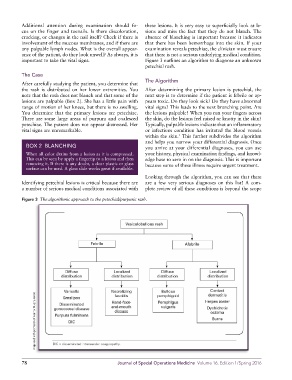
                                                             petechial rash.
          The Case
                                                             The Algorithm
          After carefully studying the patient, you determine that
          the rash is distributed on her lower extremities. You   After determining the primary lesion is petechial, the
          note that the rash does not blanch and that some of the   next step is to determine if the patient is febrile or ap-
          lesions are palpable (Box 2). She has a little pain with   pears toxic. Do they look sick? Do they have abnormal
          range of motion of her knees, but there is no swelling.   vital signs? This leads to the next branching point. Are
          You determine that the primary lesions are petechiae.   the lesions palpable? When you run your fingers across
          There  are  some  large  areas  of  purpura  and  coalesced   the skin, do the lesions feel raised or knotty in the skin?
          petechiae. The patient does not appear distressed. Her   Typically, palpable lesions indicate that an inflammatory
          vital signs are unremarkable.                      or infectious condition has irritated the blood vessels
                                                             within the skin.  This further subdivides the algorithm
                                                                           1
                                                             and helps you narrow your differential diagnosis. Once
            BOX 2  BLANCHING                                 you arrive at your differential diagnoses, you can use
            When all color drains from a lesion as it is compressed.   your history, physical examination findings, and knowl-
            This can be seen by apply a fingertip to a lesion and then   edge base to zero in on the diagnosis. This is important
            removing it. If there is any doubt, a clear plastic or glass   because some of these illness require urgent treatment.
            surface can be used. A glass slide works great if available.
                                                             Looking through the algorithm, you can see that there
          Identifying petechial lesions is critical because there are   are  a  few  very  serious  diagnoses  on  this  list!  A  com-
          a number of serious medical conditions associated with   plete review of all these conditions is beyond the scope

          Figure 3  The algorithmic approach to the petechial/purpuric rash.


                Image used with permission of Heather Murphy-Lavoie.


          78                                      Journal of Special Operations Medicine  Volume 16, Edition 1/Spring 2016

