


Page 93 - Journal of Special Operations Medicine - Spring 2016
P. 93
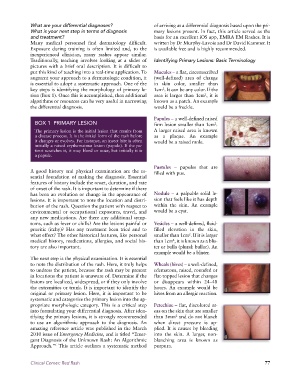
What are your differential diagnoses?              of arriving at a differential diagnosis based upon the pri-
              What is your next step in terms of diagnosis       mary lesions present. In fact, this article served as the
              and treatment?                                     basis for an excellent iOS app, EMRA EM Rashes. It is
              Many medical personnel find dermatology difficult.   written by Dr Murphy-Lavoie and Dr David Kammer. It
              Exposure during training is often limited and, to the   is available free and is highly recommended.
              inexperienced clinician, many rashes appear similar.
              Traditionally, teaching involves looking at a slides of   Identifying Primary Lesions: Basic Terminology
              pictures with a brief oral description. It is difficult to
              put this kind of teaching into a real-time application. To   Macules – a flat, circumscribed
              augment your approach to a dermatologic condition, it   (well-defined) area of change
              is essential to adopt a systematic approach. One of the   in  skin  color,  smaller  than
              key steps is identifying the morphology of primary le-  1cm . It can be any color. If the
                                                                    2
              sion (Box 1). Once this is accomplished, then additional   area is larger than 1cm , it is
                                                                                      2
              algorithms or resources can be very useful in narrowing   known as a patch. An example
              the differential diagnosis.                        would be a freckle.

                                                                 Papules – a well-defined raised
               BOX 1  PRIMARY LESION                             firm lesion smaller than 1cm .
                                                                                          2
               The primary lesion is the initial lesion that results from   A larger raised area is known
               a disease process. It is the initial form of the rash before   as a plaque. An example
               it changes or evolves. For instance, an insect bite is often   would be a raised mole.
               initially a raised erythematous lesion (papule). If the pa-
               tient scratches it, it may bleed or ooze, but initially it is
               a papule.

                                                                 Pustules –  papules that are
              A good history and physical examination are the es-  filled with pus.
              sential foundation of making the diagnosis. Essential
              features of history include the onset, duration, and rate
              of onset of the rash. It is important to determine if there
              has been an evolution or change in the appearance of   Nodule – a palpable solid le-
              lesions. It is important to note the location and distri-  sion that feels like it has depth
              bution of the rash. Question the patient with respect to   within the skin. An example
              environmental or occupational exposures, travel, and   would be a cyst.
              any new medications. Are there any additional symp-
              toms, such as fever or chills? Are the lesions painful or   Vesicles – a well-defined, fluid-
              pruritic (itchy)? Has any treatment been tried and to   filled elevation in the skin,
              what effect? The other historical features, like personal   smaller than 1cm . If it is larger
                                                                               2
              medical history, medications, allergies, and social his-  than 1cm , it is known as a blis-
                                                                        2
              tory are also important.                           ter or bulla (plural: bullae). An
                                                                 example would be a blister.
              The next step is the physical examination. It is essential
              to note the distribution of the rash. Here, it truly helps   Wheals (hives) – a well-defined,
              to undress the patient, because the rash may be present   edematous, raised, rounded or
              in locations the patient is unaware of. Determine if the   flat-topped lesion that changes
              lesions are localized, widespread, or if they only involve   or disappears within 24–48
              the extremities or trunk. It is important to identify the   hours. An example would be
              original or primary lesion. Here, it is important to be   hives from an allergic reaction.
              systematic and categorize the primary lesion into the ap-
              propriate morphologic category. This is a critical step   Petechiae – flat, discolored ar-
              into formulating your differential diagnosis. After iden-  eas on the skin that are smaller
              tifying the primary lesions, it is strongly recommended   than 3mm  and do not blanch
                                                                          2
              to use an algorithmic approach to the diagnosis. An   when  direct  pressure  is  ap-
              amazing reference article was published in the March   plied. It is causes by bleeding
              2010 issue of Emergency Medicine, and is titled “Emer-  into the skin. A larger, non-
              gent Diagnosis of the Unknown Rash: An Algorithmic   blanching area is known as
              Approach.”  This article outlines a systematic method   purpura.
                        1


              Clinical Corner: Red Rash                                                                       77

