


Page 98 - Journal of Special Operations Medicine - Spring 2016
P. 98
evidence that sleep is involved in converting new infor-  Finally, overwhelming evidence confirms that inade-
          mation  from  short-term  into  long-term  memory  over   quate sleep results in adverse health outcomes. Extreme
          the course of attempting to master a complex skill.    cases of insufficient sleep have been linked to metabolic
                                                         10
          Thus, over time, if one is trying to learn a new skill and   syndrome, 21,22  impaired immune function,  cardiovas-
                                                                                                  23
          not getting enough sleep on a regular basis, it may be   cular disease,  type 2 diabetes,  and even mortality. 26,27
                                                                        24
                                                                                        25
          very difficult to master that particular skill. Moreover,
            insufficient sleep leads to impaired alertness and perfor-  Although limited evidence indicates that getting more
          mance that will accrue across the days and weeks of too   sleep actually improves health, sufficient sleep is clearly
          little sleep. 11,12  These impairments for new learning and   linked to better cognitive performance outcomes includ-
          reductions in cognitive performance can greatly impact   ing faster performance on vigilance tasks and fewer
          a leader or individual’s ability to effectively do their job   lapses in attention, 28,29  as well as increased vigor
                                                                                                            30
          and thereby reduce the likelihood of mission success or   and better physical performance. Specifically, scien-
          of accomplishing the intended goal.                tific evidence suggests that athletic performance can
                                                             be improved by extending sleep (8–10 hours in bed) at
          Of particular military relevance is the link between the   night. 31,32
          experience of stress and decreased cognitive function.
          Specifically, stress  endured during combat-like  train-  Beyond cognitive and physical performance, emotional
          ing (e.g., US Navy SEAL training) has been shown to   and social functioning are impacted by the amount of
          negatively  impact  all  cognitive  functions,  from  simple   sleep a person gets each night. Getting 8 hours of sleep
          reaction  time  and  vigilance  to  complex  functions  like   increases optimistic outlook and social functioning,
                                                                                                            33
          memory and logical reasoning.  Insufficient sleep is an   whereas those who are chronically sleep restricted have
                                     13
          extreme stressor, and when combat stressors are cou-  reduced resilience to stress-related disorders such as
          pled with periods of insufficient sleep, the negative ef-  posttraumatic stress disorder and depression. 34–38
          fects on performance and mission success are likely to
          be compounded.                                     Individuals are typically unaware of the extent to which
                                                             their performance is compromised by lack of sleep. Im-
          Sleep loss also affects the efficiency of many bodily pro-  portantly, physiologic measures of adaptation across
          cesses and the ability to use or store energy, which can   numerous studies indicate it is impossible to adjust to
          result in a reduced capacity to meet demands of effort   or train for chronic sleep restriction. 39,40  Not only are
          and overall performance decrements (Table 1). (For a   individuals bad judges of how lack of sleep affects them,
          comprehensive  review  of  these  physiological  effects,   they are also poor at reporting how much sleep they
          see Engle-Friedman. ) Additionally sleep loss impairs   actually get. In fact, after experiencing continual sleep
                            14
          the body’s ability to regulate temperature. A number   restriction or deprivation, people become so used to it,
          of studies have shown that sleep loss and generalized   that they might think they do not need more sleep. They
          fatigue, in particular, are among the most common pre-  are wrong, and this lack of insight occurs because areas
          disposing factors for exertional heat stroke. 15–18  Thus,   of the brain (e.g., prefrontal cortices) needed to make
          insufficient sleep can compromise mission success by its   an accurate assessment of their abilities are impaired by
          potential to increase the risk of exertional heat illness.  sleep loss. Because self-report of sleep loss does not al-
                                                             ways accurately reflect the actual level of impairment,
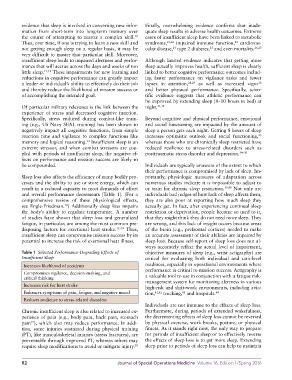
          Table 1  Selected Performance-Degrading Effects of   objective measures of sleep (e.g., wrist actigraphy) are
          Insufficient Sleep                                 critical for evaluating both individual and unit-level
           Increases likelihood of accidents                 readiness, especially in operational environments where
           Compromises vigilance, decision-making, and       performance is critical to mission success. Actigraphy is
           critical thinking                                 a valuable tool to use in conjunction with a fatigue risk-
           Increases risk for heat stroke                    management system for monitoring alertness in various
                                                             high-risk and shift-work environments, including avia-
           Enhances symptoms of pain, fatigue, and negative mood  tion, 41,42  trucking,  and hospitals. 44
                                                                            43
           Reduces resilience to stress-related disorders
                                                             Individuals are not immune to the effects of sleep loss.
          Chronic insufficient sleep is also related to increased ex-  Furthermore, during periods of extended wakefulness,
          perience of pain (e.g., body pain, back pain, stomach   the decrementing effects of sleep loss cannot be reversed
          pain ), which also may reduce performance. In addi-  by physical exercise, work breaks, posture, or physical
              19
          tion,  some  injuries  sustained  during  physical  training   fitness. As it stands right now, the only way to prepare
          (PT), like musculoskeletal injuries (stress fractures), are   for periods of insufficient sleep or to effectively reverse
          preventable through improved PT, whereas others may   the effects of sleep loss is to get more sleep. Extending
          require sleep modifications to avoid or mitigate injury. 20  sleep prior to periods of sleep loss can help to  maintain


          82                                      Journal of Special Operations Medicine  Volume 16, Edition 1/Spring 2016

