


Page 99 - Journal of Special Operations Medicine - Spring 2016
P. 99
performance and may even increase resilience and facili-  effects, length of continued wakefulness, time of day, and
              tate recovery after these periods. 40              cumulative effects of sleep loss. Research suggests that al-
                                                                 though no person can go without sleep for extended peri-
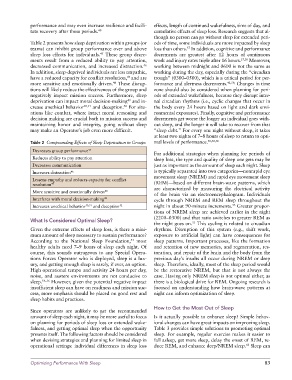
              Table 2 presents how sleep deprivation within groups (or   ods of time, some individuals are more impacted by sleep
              teams) can inhibit group performance over and above   loss than others.  In addition, cognitive and performance
                                                                              57
              sleep loss effects for individuals.  These group decre-  decrements are greatest after 12 hours of continuous
                                          45
              ments result from a reduced ability to pay   attention,   work and injury rates triple after 16 hours. 57,58  Moreover,
                decreased communication, and increased distraction.    working between midnight and 0600 is not the same as
                                                            46
              In addition, sleep-deprived individuals are less empathic,   working during the day, especially during the “circadian
              have a reduced capacity for conflict resolution,  and are   trough” (0300–0500), which is a critical period for per-
                                                     47
              more sensitive and emotionally driven.  These disrup-  formance and alertness decrements. 42,59,  Changes in time
                                                48
              tions will likely reduce the effectiveness of the group and   zone should also be considered when planning for peri-
              negatively impact mission success. Furthermore, sleep   ods of extended wakefulness, because they disrupt inter-
              deprivation can impact moral decision-making  and in-  nal circadian rhythms (i.e., cyclic changes that occur in
                                                      49
              crease unethical behavior 50,51  and deception.  For situ-  the body every 24 hours based on light and dark envi-
                                                    52
              ations like combat, where intact moral reasoning and   ronmental exposures). Finally, cognitive and performance
              decision making are crucial both to mission success and   decrements get worse the longer an individual goes with-
              maintaining honor and integrity, going without sleep   out sleep, and the longer it will take to recover from that
              may make an Operator’s job even more difficult.    “sleep debt.” For every one night without sleep, it takes
                                                                 at least two nights of 7–8 hours of sleep to return to opti-
              Table 2  Compounding Effects of Sleep Deprivation in Groups  mal levels of performance. 40,42,58
              Decreases group performance 45
                                                                 For additional strategies when planning for periods of
              Reduces ability to pay attention                   sleep loss, the type and quality of sleep one gets may be
              Decreases communication                            just as important as the amount of sleep each night. Sleep
              Increases distraction 46                           is typically separated into two categories—nonrapid eye
                                                                 movement sleep (NREM) and rapid eye movement sleep
              Lessens empathy and reduces capacity for conflict
              resolution 47                                      (REM)—based on different brain-wave patterns, which
                                                                 are characterized by measuring the electrical activity
              More sensitive and emotionally driven 48
                                                                 of the brain via an electroencephalogram. Individuals
              Interferes with moral decision-making 49           cycle through NREM and REM sleep throughout the
                                                                                                 53
              Increases unethical behavior 50,51  and deception 52  night in about 90-minute increments.  Greater propor-
                                                                 tions of NREM sleep are achieved earlier in the night
                                                                 (2200–0300) and that ratio switches to greater REM as
              What Is Considered Optimal Sleep?
                                                                 the night goes on.  This cycling is related to circadian
                                                                                53
              Given the extreme effects of sleep loss, is there a mini-  rhythms. Disruption of this system  (e.g., shift work,
              mum amount of sleep necessary to sustain performance?   exposure to artificial light) can have consequences for
              According to the National Sleep Foundation,  most   sleep patterns. Important processes, like the formation
                                                       53
              healthy adults need 7–9 hours of sleep each night. Of   and retention of new memories, and regeneration, res-
              course, this sounds outrageous to any Special Opera-  toration, and repair of the brain and the body from the
              tions Forces Operator who is deployed, sleep is a lux-  previous day’s insults all occur during NREM or deep
              ury, and getting enough sleep is rarely, if ever, an option.   sleep. Therefore, ideally, most of the sleep period would
              High operational tempo and activity 24 hours per day,   be the restorative NREM, but that is not always the
              noise, and austere environments are not conducive to   case. Having only NREM sleep is not optimal either, as
              sleep. 54–56  However, given the potential negative impact   there is a biological drive for REM. Ongoing research is
              insufficient sleep can have on readiness and mission suc-  focused on understanding how brain-wave patterns at
              cess, more emphasis should be placed on good rest and   night can inform optimization of sleep.
              sleep habits and practices.
                                                                 How to Get the Most Out of Sleep
              Since operators are unlikely to get the recommended
              amount of sleep each night, it may be more useful to focus   Is it actually possible to enhance sleep? Simple behav-
              on planning for periods of sleep loss or extended wake-  ioral changes can have great impacts on improving sleep.
              fulness, and getting optimal sleep when the opportunity   Table 3 provides simple solutions to promoting optimal
              presents itself. The following factors should be considered   sleep. For example, regular exercise makes it easier to
              when devising strategies and planning for limited sleep in   fall asleep, get more sleep, delay the onset of REM, re-
              operational settings: individual differences in sleep loss   duce REM, and enhance deep/NREM sleep.  Sleep can
                                                                                                       60


              Optimizing Performance With Sleep                                                               83

