


Page 92 - Journal of Special Operations Medicine - Spring 2016
P. 92
An Ongoing Series


                                                     Red Rash


                                         Joshua Banting; Tony Meriano, MD


          CONCEPTS AND OBJECTIVES
          The  series  objective  is to review  various  clinical  con-  diagnosed the individual with insect bites, but just
          ditions/presentations, including the latest evidence on   wanted to get your opinion.
          management, and to dispel common myths. In the pro-
          cess, core knowledge and management principles are   The patient is a 29-year-old female intelligence analyst.
          enhanced. A clinical case will be presented. Cases will   She looks well and is in no distress. She has no significant
          be drawn from real life but phrased in a context that is   prior medical illness. She takes oral contraceptives, her
          applicable to the Special Operations Forces (SOF) or   antimalarial medication is doxycycline, and she has no
          tactical emergency medical support (TEMS) environ-  allergies. She has never had a rash like this before. She
          ment. Details will be presented in such a way that the   has remained inside the wire for the entire rotation.
          reader can follow along and identify how they would
          manage the case clinically depending on their experi-  She is alert and in no significant distress. Her heart rate
          ence and environment situation. Commentary will be   is 86, respiratory rate is 12, oxygen saturation level is
          provided by currently serving military medical techni-  98%, and temperature is 37°C. There is a rash on her
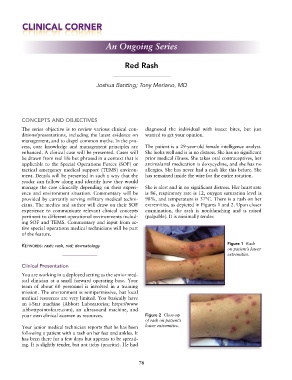
          cians. The medics and author will draw on their SOF   extremities, as depicted in Figures 1 and 2. Upon closer
          experience to communicate relevant clinical concepts   examination, the rash is nonblanching and is raised
          pertinent to different operational environments includ-  (palpable). It is minimally tender.
          ing SOF and TEMS. Commentary and input from ac-
          tive special operations medical technicians will be part
          of the feature.
                                                                                               Figure 1  Rash
          Keywords: rash; rash, red; dermatology
                                                                                               on patient’s lower
                                                                                               extremities.

          Clinical Presentation
          You are working in a deployed setting as the senior med-
          ical clinician at a small forward operating base. Your
          team  of  about  60  personnel  is  involved  in  a  training
          mission. The environment is semipermissive, but local
          medical resources are very limited. You basically have
          an i-Stat machine (Abbott Laboratories; https://www
          .abbottpointofcare.com), an ultrasound machine, and
          your own clinical acumen as resources.             Figure 2  Close-up
                                                             of rash on patient’s
          Your junior medical technician reports that he has been   lower extremities.
          following a patient with a rash on her feet and ankles. It
          has been there for a few days but appears to be spread-
          ing. It is slightly tender, but not itchy (pruritic). He had


                                                          76

