


Page 88 - Journal of Special Operations Medicine - Spring 2016
P. 88
Casualty care supply vendors Combat Medical Sys-
                 Needle Decompression                        tems  (http://www.combatmedicalsystems.com),  H&H
                                                             Medical (http://buyhandh.com), and North American
          by Nicholas M. Studer, MD, EMT-P; Gregory T. Horn, MD  Rescue Products (http://www.narescue.com) produce
                                                             near-identical ruggedized packaging that is similar to a
                                                                      10
                                                             cigar tube.  They omit the flash cap and have a single-
                  hile the incidence of tension pneumothorax   component protective sheath, thus eliminating the prob-
                  in  American  war-wounded  Servicemembers
          Whas decreased since the introduction of body      lems with using the BD device (Figure 1). For this reason,
                                                             they are specified for most field medical equipment sets.
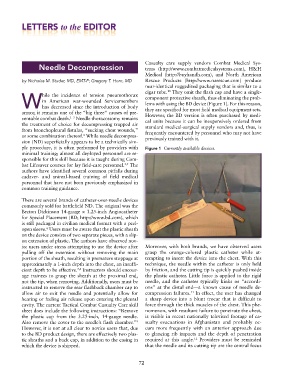
          armor, it remains one of the “big three” causes of pre-  However, the BD version is often purchased by medi-
                              1–3
          ventable combat death.  Needle thoracostomy remains   cal units because it can be inexpensively ordered from
          the treatment of choice for decompressing trapped air   standard medical-surgical supply vendors and, thus, is
          from bronchopleural fistulas, “sucking chest wounds,”   frequently encountered by personnel who may not have
          or some combination thereof.  While needle decompres-  previously trained with it.
                                   4
          sion (ND) superficially appears to be a technically sim-
          ple procedure, it is often performed by providers with   Figure 1  Currently available devices.
          minimal training; almost all deployed personnel are re-
          sponsible for this skill because it is taught during Com-
          bat Lifesaver courses for lay field-care personnel.  The
                                                    3,5
          authors have identified several common pitfalls during
          cadaver-  and animal-based  training  of  field  medical
          personnel that have not been previously emphasized in
          common training guidance.

          There are several brands of catheter-over-needle devices
          commonly sold for battlefield ND. The original was the
          Becton Dickinson 14-gauge × 3.25-inch Angiocatheter
          for Special Placement (BD; http://www.bd.com), which
          is still packaged in civilian medical format with a peel-
                    6
          open sleeve.  Users must be aware that the plastic sheath
          on the device consists of two separate pieces, with a slip-
          on extension of plastic. The authors have observed nov-
          ice users under stress attempting to use the device after   Moreover, with both brands, we have observed users
          pulling off the extension without removing the main   grasp the orange-colored plastic catheter while at-
          portion of the sheath, resulting in premature stoppage at   tempting to insert the device into the chest. With this
          approximately a 1-inch depth into the chest, an insuffi-  technique, the needle within the catheter is only held
          cient depth to be effective.  Instructors should encour-  by friction, and the cutting tip is quickly pushed inside
                                 7,8
          age trainees to grasp the sheath at the proximal end,   the plastic catheter. Little force is applied to the rigid
          not the tip, when removing. Additionally, users must be   needle, and the catheter typically kinks or “accordi-
          instructed to remove the rear flashback chamber cap to   ons” at the distal end—a known cause of needle de-
          allow air to exit the needle and potentially allow for   compression failures.  In effect, the user has changed
                                                                                11
          hearing or feeling air release upon entering the pleural   a sharp device into a blunt trocar that is difficult to
          cavity. The current Tactical Combat Casualty Care skill   force through the thick muscles of the chest. This phe-
          sheet does include the following instructions: “Remove   nomenon, with resultant failure to penetrate the chest,
          the plastic cap from the 3.25-inch, 14-gauge needle.   is visible in recent nationally televised footage of ca-
          Also remove the cover to the needle’s flash chamber.”    sualty evacuations in Afghanistan and probably oc-
                                                         9
          However, it is not at all clear to novice users that, due   curs more frequently with an anterior approach due
          to the BD product design, there are effectively two plas-  to glancing rib impacts and the depth of penetration
          tic sheaths and a back cap, in addition to the casing in   required at this angle.  Providers must be reminded
                                                                                 12
          which the device is shipped.                       that the needle and its cutting tip are the central  focus


                                                          72

