


Page 30 - Journal of Special Operations Medicine - Spring 2016
P. 30
Short Report Comparing Generation 6 Versus

                 Prototype Generation 7 Combat Application Tourniquet
                                                                                                     ®
                                   in a Manikin Hemorrhage Model


                     John F. Kragh Jr, MD; Virgil K. Moore III, BBA; James K. Aden 3rd, PhD;
                                  Donald L. Parsons, PA; Michael A. Dubick, PhD


          ABSTRACT
          Background: The Combat Application Tourniquet      Resources; http://combattourniquet.com) is the standard-
                                                         ®
          (C-A-T) is the standard-issue military tourniquet used in   issue military tourniquet used in first aid in 2015. The
          first aid in 2015, and the current model is called Genera-  C-A-T is in its sixth version, called Generation 6, as there
          tion 6. Soldiers in the field, however, have been asking for   have been five sets of refinements in its design over the
          design changes in a possible Generation 7 to improve ease   past decade.  C-A-T Generation 6 (C-A-T 6) has been
                                                                        8,9
          of use. This study compared the differential performance   bought worldwide over the past several years. However,
          in use of the C-A-T in two designs: Generation 6 (C-A-T   Servicemembers in the field have been asking for design
          6) versus a prototype Generation 7 (C-A-T 7). Methods:   changes in the current Generation 6 to improve ease of
          A laboratory experiment was designed to test the perfor-  use in a possible Generation 7 version (C-A-T 7).  The
                                                                                                        10
          mance of two tourniquet designs in hemorrhage control,   purpose of the present study was to compare the differ-
          ease  of  use,  and  user  preference.  Ten  users of the two    ential performance in use of the C-A-T in two designs:
          C-A-T models placed them on a manikin thigh to stop   C-A-T 6 versus a prototype C-A-T 7 (Figures 1 and 2).
          simulated bleeding. Users included trauma researchers
          and instructors of US Army student medics. Ten users con-  Methods
          ducted 20 tests (10 each of both designs). Results: Most re-
          sults were not statistically significant in their difference by    This study was conducted under a protocol for a lab-
          C-A-T design. The mean difference in blood loss was sta-  oratory  experiment  designed  to  compare  the  function
          tistically significant (p = .03) in that the C-A-T 7 performed   of tourniquets and was reviewed and approved by the
          better than the C-A-T 6, but only in the mixed statistical   Regulatory Compliance Division of the US Army Insti-
          model analysis of variance, which accounted for user ef-  tute of Surgical Research. The experiment was designed
          fects. The difference in ease-of-use score was statistically   to test the performance of two tourniquet designs in
          significant (p = .002); the C-A-T 7 was easier. All users
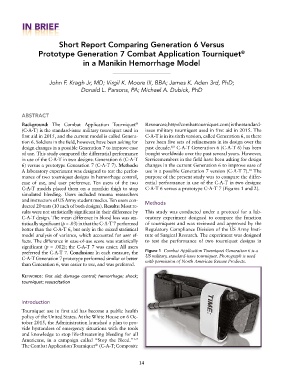
          preferred the C-A-T 7. Conclusion: In each measure, the   Figure 1  Combat Application Tourniquet Generation 6 is a
          C-A-T Generation 7 prototype performed similar or better   US military, standard-issue tourniquet. Photograph is used
                                                             with permission of North American Rescue Products.
          than Generation 6, was easier to use, and was preferred.
          Keywords:  first aid; damage control; hemorrhage; shock;
          tourniquet; resuscitation


          Introduction
          Tourniquet use in first aid has become a public health
          policy of the United States. At the White House on 6 Oc-
          tober 2015, the Administration launched a plan to pro-
          vide bystanders of emergency situations with the tools
          and knowledge to stop life-threatening bleeding for all
          Americans, in a campaign called “Stop the Bleed.”
                                                        1–7
          The Combat Application Tourniquet   (C-A-T; Composite
                                        ®

                                                          14

