


Page 31 - Journal of Special Operations Medicine - Spring 2016
P. 31
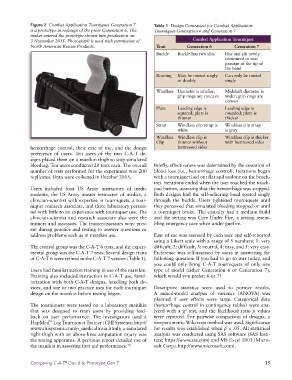
Figure 2  Combat Application Tourniquet Generation 7    Table 1  Design Contrasted for Combat Application
              is a prototype in redesign of the prior Generation 6. The   Tourniquet Generation 6 and Generation 7
              maker entered the prototype shown into production on
              3 November 2015. Photograph is used with permission of             Combat Application Tourniquet
              North American Rescue Products.                     Trait       Generation 6        Generation 7
                                                                  Buckle  Buckle has two slits  Has one slit newly
                                                                                              contoured to ease
                                                                                              passage of the tip of
                                                                                              the band
                                                                  Routing  May be routed singly   Can only be routed
                                                                          or doubly           singly

                                                                  Windlass Diameter is smaller;   Midshaft diameter is
                                                                          grip rings are concave  wider; grip rings are
                                                                                              convex
                                                                  Plate   Leading edge is     Leading edge is
                                                                          squared; plate is   rounded; plate is
                                                                          thinner             thicker
                                                                  Strap   Windlass clip strap is   Windlass clip strap
                                                                          white               is gray
                                                                  Windlass  Windlass clip is   Windlass clip is thicker
                                                                  Clip    thinner without     with buttressed sides
                hemorrhage control, their ease of use, and the design     buttressed sides
              preference of users. Ten users of the two C-A-T de-
              signs placed them on a manikin thigh to stop simulated
              bleeding. Ten users conducted 20 tests each. The overall   Briefly, effectiveness was determined by the cessation of
              number of tests performed for the experiment was 200   blood loss (i.e., hemorrhage control). Iterations began
              replicates. Data were collected in October 2015.   with a tourniquet laid out flat and undone on the bench-
                                                                 top. Iterations ended when the user touched the touch-
              Users included four US Army instructors of medic   pad button, assessing that the hemorrhage was stopped.
              students, the US Army master instructor of medics, a   Both designs had the self-adhering band routed singly
              clinician-scientist with expertise in tourniquets, a tour-  through  the  buckle.  Users  tightened  tourniquets  until
              niquet research associate, and three laboratory person-  they perceived that simulated bleeding stopped or until
              nel with little to no experience with tourniquet use. The   a tourniquet broke. The casualty had a medium build
              clinician-scientist and research associate also were the   and the setting was Care Under Fire, a setting resem-
              trainers and assessors. The trainer-assessors were pres-  bling emergency care when under gunfire.
              ent during practice and testing to answer questions or
              address problems such as in manikin use.           Ease of use was assessed by each user and self-reported
                                                                 using a Likert scale with a range of 5 numbers: 1: very
              The control group was the C-A-T 6 tests, and the experi-  difficult, 2: difficult, 3: neutral, 4: easy, and 5: very easy.
              mental group was the C-A-T 7 tests. Several design traits   Preference was self-assessed by users in answering the
              of C-A-T 6 were refined in the C-A-T 7 version (Table 1).  following question: If you had to go to war today, and
                                                                 you could only bring C-A-T  tourniquets of only one
              Users had familiarization training in use of the manikin.   type of model (either Generation 6 or Generation 7),
              Training also included instruction in C-A-T use, famil-  which would you prefer: 6 or 7?
              iarization with both C-A-T designs, handling both de-
              vices, and one or two practice uses for each tourniquet   Descriptive statistics were used to portray results.
              design on the manikin before testing began.        A mixed-model analysis of variance (ANOVA) was
                                                                 planned  if  user  effects  were  large.  Categorical  data
              The tourniquets were tested on a laboratory manikin   (hemorrhage control in contingency tables) were ana-
              that was designed to train users by providing feed-  lyzed with a χ  test, and the likelihood ratio p values
                                                                              2
              back on user performance.  The investigators  used a   were reported. For pairwise comparison of designs, a
              HapMed  Leg Tourniquet Trainer (CHI Systems; http://  nonparametric Wilcoxon method was used. Significance
                     ™
              www.chisystems.com/p_medicaltrain.html); a simulated   for results was established when p < .05. All statistical
              right thigh with an above-knee amputation injury was   analysis was conducted using SAS software (SAS Insti-
              the testing apparatus. A previous report detailed use of   tute; https://www.sas.com) and MS Excel 2003 (Micro-
              the manikin in assessing first aid performance. 10  soft Corp.; http://www.microsoft.com).


              Comparing C-A-T  Gen 6 to Prototype Gen 7                                                       15
                            ®

