


Page 20 - Journal of Special Operations Medicine - Spring 2016
P. 20
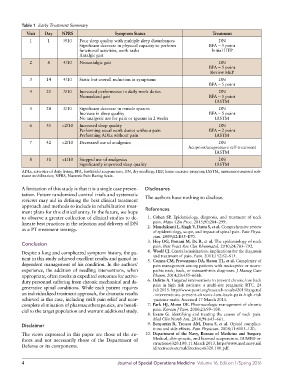
Table 1  Early Treatment Summary
            Visit   Day    NPRS                 Symptom Status                           Treatment
             1       1     9/10   Poor sleep quality with multiple sleep disturbances      DN
                                  Significant decrease in physical capacity to perform   BFA – 5 point
                                  functional activities, work tasks                     Initial HEP
                                  Antalgic gait
             2       8     4/10   Nonantalgic gait                                         DN
                                                                                       BFA – 5 point
                                                                                        Review HEP
             3      14     4/10   Static but overall reduction in symptoms                 DN
                                                                                       BFA – 5 point
             4      21     3/10   Increased performance in daily work duties               DN
                                  Normalized gait                                      BFA – 5 point
                                                                                          IASTM
             5      28     2/10   Significant decrease in muscle spasms                    DN
                                  Increase in sleep quality                            BFA – 5 point
                                  No analgesic use for pain or spasms in 2 weeks          IASTM
             6      35     <2/10  Increased sleep quality                                  DN
                                  Performing usual work duties without pain            BFA – 2 point
                                  Performing ADLs without pain                            IASTM
             7      42     <2/10  Decreased use of analgesics                              DN
                                                                               Acupoint/acupressure self-treatment
                                                                                          IASTM
             8      51     <1/10  Stopped use of analgesics                                DN
                                  Significantly improved sleep quality                    IASTM
          ADLs, activities of daily living; BFA, battlefield acupuncture; DN, dry needling; HEP, home exercise program; IASTM, instrument-assisted soft-
          tissue mobilization; NPRS, Numeric Pain Rating Scale.

          A limitation of this study is that it is a single case presen-  Disclosures
          tation. Future randomized control trials and systematic   The authors have nothing to disclose.
          reviews may aid in defining the best clinical treatment
          approach and methods to include in rehabilitation treat-  References
          ment plans for this clinical entity. In the future, we hope
          to observe a greater collection of clinical studies to de-    1.  Cohen  SP. Epidemiology, diagnosis,  and treatment  of neck
          lineate best practices in the selection and delivery of DN   pain. Mayo Clin Proc. 2015;90:284–299.
          as a PT treatment strategy.                          2.  Manchikanti L, Singh V, Datta S, et al. Comprehensive review
                                                                of epidemiology, scope, and impact of spinal pain. Pain Physi-
                                                                cian. 2009;12:E35–E70.
          Conclusion                                           3.  Hoy DG, Protani M, De R, et al. The epidemiology of neck
                                                                pain. Best Pract Res Clin Rheumatol. 2010;24:783–792.
          Despite a long and complicated symptom history, the pa-    4.  Woolf CJ. Central sensitization: implications for the diagnosis
                                                                and treatment of pain. Pain. 2011;152:S2–S15.
          tient in this study achieved excellent results and gained in-    5.  Cozma CM, Provenzano DA, Slaton TL, et al. Complexity of
          dependent management of his condition. In the authors’   pain management among patients with nociceptive or neuro-
          experience, the addition of needling interventions, when   pathic neck, back, or osteoarthritis diagnoses. J Manag Care
          appropriate, often results in expedited outcomes for active-  Pharm. 2014;20:455–666b.
          duty personnel suffering from chronic mechanical and de-    6.  Delitto A. Targeted interventions to prevent chronic low back
          generative spinal conditions. While each patient requires   pain in high risk patients: a multi-site pragmatic RTC. 24
                                                                Feb 2015. http://www.pcori.org/research-results/2015/targeted
          an individualized treatment approach, the dramatic results   -interventions-prevent-chronic-low-back-pain-high-risk
          achieved in this case, including swift pain relief and near-  -patients-multi. Accessed 17 March 2015.
          complete elimination of pharmacotherapeutics, are benefi-    7.  Park HJ, Moon DE. Pharmacologic management of chronic
          cial to the target population and warrant additional study.  pain. Korean J Pain. 2010;23:99–108.
                                                               8.  Evans  G.  Identifying  and  treating  the  causes  of  neck  pain.
                                                                Med Clin North Am. 2014;98:645–661.
          Disclaimer                                           9.  Benyamin R, Trescot AM, Datta S, et al. Opioid complica-
                                                                tions and side-effects. Pain Physician. 2008;11:S105–120.
          The views expressed in this paper are those of the au-  10.  Department of the Navy, Bureau of Medicine and Surgery.
          thors and not necessarily those of the Department of   Medical, chiropractic, and licensed acupuncture. BUMED in-
          Defense or its components.                            struction 6320.100. 11 March 2013. http://www.med.navy.mil
                                                                /directives/externaldirectives/6320.100.pdf.


          4                                       Journal of Special Operations Medicine  Volume 16, Edition 1/Spring 2016

