


Page 19 - Journal of Special Operations Medicine - Spring 2016
P. 19
Treatment                                          subsequent response is provided in Table 1. The patient
              After completion of the initial evaluation, the plan of care   reported a reduction of neck pain from 9/10 to 0–2/10
              (POC) was discussed with the patient, and consent for   within five treatment sessions (1 month), achieving his
              treatment obtained. The POC for this patient included   symptom goals and facilitating increased participation
              initial treatment with education on the  pathokinesiology   in home and work responsibilities. The patient also re-
              of his neck pain, DN, BFA, and instrument-assisted   ported a 90% reduction in the use of medication to con-
              soft-tissue mobilization of the cervicothoracic myofas-  trol pain and an 85% reduction in medication to assist in
              cial tissues. Additional interventions including postural   sleep, correlating to reduced prescription refills, accord-
              awareness, ergonomic education, and therapeutic ex-  ing to his electronic health records. The number of PT
              ercise  prescription  emphasizing  cervicothoracic  motor   treatments required to maintain the patient’s pain levels
              control were integrated during the course of treatment.   averaged three visits per month over the next 6 months,
              Specific joint-mobilization techniques were mostly   and fewer than one visit per month over an additional 6
              avoided because of a past medical history of multilevel   months. He was followed for 29 months, during which
              fusion, as well as low patient tolerance.          he engaged in an independent PT maintenance program.

              DN treatment included intervention to tender tissues of   Discussion
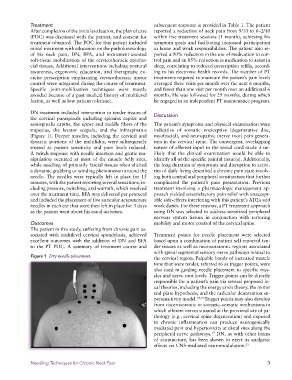
              the  cervical paraspinals  including splenius  capitis and
              semispinalis capitis, the upper and middle fibers of the   The patient’s symptoms and physical examination were
              trapezius, the levator scapula, and the infraspinatus   indicative of somatic nociceptive  (degenerative disc,
              (Figure 1). Deeper muscles, including the cervical and   myofascial), and neuropathic (nerve root) pain genera-
              thoracic portions of the multifidus, were subsequently   tors in the cervical spine. The convergent, overlapping
              treated as patient sensitivity and pain levels reduced.   nature of afferent input to the spinal cord made it un-
              A twitch response with needle insertion and gentle ma-  likely that the clinical examination would be able to
              nipulation occurred at most of the muscle belly sites,   identify all of the specific painful tissue(s). Additionally,
              while needling of primarily fascial tissues often elicited   the long duration of symptoms and disruption to activi-
              a dynamic grabbing or winding phenomenon around the   ties of daily living described a chronic pain state involv-
              needle.  The  needles  were  typically  left  in  place  for  15   ing both central and peripheral sensitization that further
              minutes, with the patient reporting several sensations, in-  complicated the patient’s pain presentation. Previous
              cluding pressure, twitching, and warmth, which resolved   treatment involving a pharmacologic management ap-
              over the treatment time. BFA was delivered per protocol   proach yielded unsatisfactory pain relief with unaccept-
              and included the placement of five auricular acupuncture   able side-effects interfering with this patient’s ADLs and
              needles in each ear that were then left in place for 3 days   work duties. For these reasons, a PT treatment approach
              as the patient went about his usual activities.    using DN was selected to address sensitized peripheral
                                                                 nervous  system  tissues  in  conjunction  with  restoring
              Outcomes                                           mobility and motor control of the cervical spine.
              The patient in this study, suffering from chronic pain as-
              sociated with multilevel cervical spondylosis, achieved   Treatment points for needle placement were selected
              excellent outcomes with the addition of DN and BFA   based upon a combination of patient self-reported ten-
              to the PT POC. A summary of treatment course and   der tissues as well as neuroanatomic regions associated
                                                                 with spinal segmental sensory-nerve pathways related to
              Figure 1  Dry needle placement.
                                                                 the cervical region. Palpable bands of increased muscle
                                                                 tone that were tender, referred to as trigger points, were
                                                                 also used in guiding needle placement to specific mus-
                                                                 cles and nerve root levels. Trigger points can be directly
                                                                 responsible for a patient’s pain via several proposed lo-
                                                                 cal theories, including the energy crisis theory, the motor
                                                                 end plate hypothesis, and the radicular denervation su-
                                                                 persensitivity model. 14,16  Trigger points may also develop
                                                                 from viscerosomatic or somatic–somatic mechanisms in
                                                                 which afferent nerves situated at the proximal site of pa-
                                                                 thology (e.g., cervical spine degeneration) and exposed
                                                                 to chronic inflammation can produce neurogenically
                                                                 mediated pain and hypertonicity at distal sites along the
                                                                 peripheral nerve pathways.  DN, as with other forms
                                                                                        17
                                                                 of acupuncture, has been shown to exert its analgesic
                                                                 effects via CNS-mediated neuromodulation. 21


              Needling Techniques for Chronic Neck Pain                                                        3

