


Page 122 - Journal of Special Operations Medicine - Spring 2016
P. 122
CASEVAC aircraft (and surveyed landing zones)  capable   decision to change the manning document for the teams
          of spanning the vast distances of the AOR, the ability of   in October 2015. This change in manning and arma-
          the teams to respond to casualties was degraded, espe-  ment replaced the three-person ECCT with a TCCET, a
          cially when engaged in remote DS during split opera-  team consisting of an emergency physician, anesthetist,
          tions. The widely dispersed threat to US forces across   and a critical care or emergency nurse whose training
          the AOR combined with the dynamic operational mis-  and equipping enhanced the ability to provide en route
          sion of US SOF in Africa prohibited a singular, fixed   damage-control resuscitation for unregulated, prehospi-
          model of deployment for the MFST and ECCT.         tal patients.

          The MFST and ECCT, though conceived and deployed to   Clinical Operations
          be capable of forward staging with man-portable equip-  Though trained, equipped, and located far forward to
          ment and to effectively conduct damage control surgery   perform lifesaving, timely surgery and resuscitation, the
          and resuscitation with eight providers, were found to   MFST and ECCT performed no surgery on US Soldiers
          make too large a footprint during some missions in Af-  during operations by SOCFWD-NWA in the first year
          rica. Faced with the challenge of limited billeting and life   of operations. To maintain currency, the MFST and
          support in far-forward desert ODA camps, the MFST   ECCT became credentialed and developed a partnership
          pared down to a three-person team on missions requir-  with two hospitals in the theater: the CURE hospital in
          ing a smaller footprint, while the remaining ECCT and   Niamey, Niger, and the Role II hospital at the French
          MFST members, far away from the three-person surgi-  Headquarters for Operation Barkhane in N’Djamena,
          cal team, continued to provide AS capability. The three-  Chad. Operating on Nigerien and Chadian patients at
          person surgical team consisted of a general surgeon, an   these two hospitals in the theater enabled US SOF and
          anesthetist, and an emergency physician, and deployed   the French, Nigerien, and Chadian militaries in Africa
          with 10 units of fresh frozen plasma, 10 units of packed   to develop stronger relationships (Figure 3). By operat-
          red blood cells, and equipment to perform one to two   ing on more than 400 surgical patients in 12 months,
                                6
          damage control surgeries.  Relying on the 18D from the   the MFST and ECCT maintained their critical care and
          ODA and his team’s equipment, power, and shelter, the   surgical skills while simultaneously assisting partner
          three-person  MFST forward deployed  to be within 1   forces and host nations.
          hour of casualties during high-risk operations.
                                                             On four occasions, the MFST and ECCT teamed with
          As DS and AS requirements dictated, the manning and   French Role II medical personnel during mass casualties
          equipping of the surgical and critical care teams was flex-  (Figure 4). In February 2015, during Operation Flint-
          ible. DS at times consisted of an emergency physician,   lock, the MFST and ECCT operated on multiple trauma
          an emergency physician and an orthopedic  surgeon, or   patients in N’Djamena because of direct action between
          the full MFST and ECCT.                            partner forces and Boko Haram. In June 2015, 29 casu-
                                                             alties were treated as a result of detonations by suicide-
          The ECCT, though conceived and equipped originally   vest-wearing members of Boko Haram in N’Djamena.
          as ground support for casualties, began to fulfill the role   The MFST, working with French Role II medics, treated
          of an en route critical care and transport team. It was
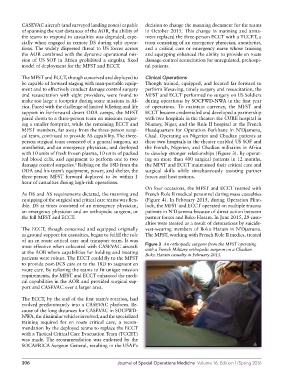
          most effective when colocated with CASEVAC aircraft   Figure 3  An orthopedic surgeon from the MFST operating
                                                             with a French Military orthopedic surgeon on a Chadian
          at the AOB where capabilities for holding and treating   Boko Haram casualty in February 2015.
          patients were robust. The ECCT could fly to the MFST
          to provide post-DCS care or to the 18D to augment en
          route care. By tailoring the teams to fit unique mission
          requirements, the MFST and ECCT enhanced the medi-
          cal capabilities in the AOR and provided surgical sup-
          port and CASEVAC over a larger area.

          The ECCT, by the end of the first team’s rotation, had
          evolved predominantly into a CASEVAC platform. Be-
          cause of the long distances for CASEVAC in SOCFWD-
          NWA, the dissimilar vehicles involved, and the specialized
          training required for en route critical care, a recom-
          mendation by the deployed teams to replace the ECCT
          with a Tactical Critical Care Evacuation Team (TCCET)
          was made. The recommendation was endorsed  by  the
            SOCAFRICA Surgeon General, resulting in the USAF’s


          106                                     Journal of Special Operations Medicine  Volume 16, Edition 1/Spring 2016

