


Page 121 - Journal of Special Operations Medicine - Spring 2016
P. 121
exercised planning for missions requiring flexibility of   area support (AS) and direct support (DS) operations in
              personnel and equipment tailored to operations con-  SOCFWD-NWA.
              ducted by US SOF.
                                                                 The distance to a surgical team prior to the MFST de-
              All MFST and ECCT members completed an Evasion     ployment put SOF at an unacceptably high risk and se-
              and Conduct After  Capture course at Lackland  Air   verely limited conduct of operations. Although French
              Force Base in San Antonio, Texas. Based on the threat   Role II hospitals were in place in N’Djamena, Chad, and
              of AQIM and Boko Haram in the AOR and the permis-  in Madama, Niger, the evacuation time for a US Soldier
              sive environment in sub-Saharan Africa, this training   ranged from 12 to 24 hours throughout the SOCFWD-
              was mandated for the MFST and ECCT. In addition,   NWA AOR. This lack of timely CASEVAC limited any
              the emergency physician from the MFST and the critical   risk management offered by the French Role II hospitals
              care physician from the ECCT attended the Operational   and prevented conduct of high-risk operations by SOF. 4
              Clinical Infectious Disease Course at the Walter Reed
              Army Institute of Research, enabling the teams to diag-  With the MFST and ECCT providing DS, the time to
              nose and treat the myriad infectious diseases endemic to   CASEVAC and damage-control surgery (DCS) was sig-
              the SOCFWD-NWA AOR.                                nificantly reduced to within 4 to 12 hours. This directly
                                                                 lowered  risks  to  SOF  from  medical  threats,  nonbattle
                                                                                         5
              After completing predeployment training, the eight-  injury, and enemy contact,  and permitted operations
              person MFST and ECCT arrived in Niamey, Niger in   to advise and assist partner nations in the interdiction
              November 2014 to conduct a 6-month tour as the first   of AQIM and Boko Haram forces. By providing DS to
              conventional surgical and critical care teams deployed   forward forces, the MFST and ECCT improved casualty
              to Africa in support of US SOF (Figure 2).         care, provided transfusion of packed red blood cells and
                                                                 plasma in the prehospital setting, and significantly re-
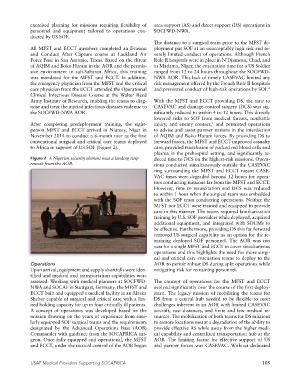
              Figure 2  A Nigerien security element near a landing strip   duced time to DCS on the highest-risk missions. Opera-
              remote from the AOB.                               tions conducted simultaneously outside the CASEVAC
                                                                 ring  surrounding  the  MFST  and  ECCT  meant  CASE-
                                                                 VAC times were degraded beyond 12 hours for opera-
                                                                 tors conducting missions far from the MFST and ECCT.
                                                                 However, time to resuscitation and DCS was reduced
                                                                 to within 1 hour when the surgical team was embedded
                                                                 with the SOF team conducting operations. Neither the
                                                                 MFST nor ECCT were trained and equipped to provide
                                                                 care in this manner. The teams required familiarization
                                                                 training by U.S. SOF providers while deployed, acquired
                                                                 additional equipment, and integrated with SOCMs to
                                                                 be effective. Furthermore, providing DS this far forward
                                                                 removed US surgical capability as an option for the re-
                                                                 maining deployed SOF personnel. The AOR was too
                                                                 vast for a single MFST and ECCT to cover simultaneous
                                                                 operations and this highlights the need for more surgi-
                                                                 cal and critical care evacuation teams to deploy to the
              Operations                                         AOR to permit robust DS during split operations while
              Upon arrival, equipment and supply shortfalls were iden-  mitigating risk for remaining personnel.
              tified and medical and transportation capabilities were
              assessed. Working with medical planners at SOCFWD-  The concept of operations for the MFST and ECCT
              NWA and SOCAF in Stuttgart, Germany, the MFST and   evolved significantly over the course of the first deploy-
              ECCT built and equipped a medical facility in an Alaska   ment. The legacy mission of mobilizing the teams for
              Shelter capable of surgical and critical care with a lim-  DS from a central hub needed to be flexible to meet
              ited holding capacity for up to four critically ill patients.   challenges inherent in an AOR with limited CASEVAC
              A concept of operations was developed based on the   aircraft, vast distances, and finite and few medical re-
              mission drawing on the years of experience from simi-  sources. The mobilization of both teams for DS missions
              larly equipped SOF surgical teams and the requirements   to remote locations meant a degradation of the ability to
              designated by the Advanced Operations Base (AOB)   provide effective AS while away from the higher medi-
              Commander with guidance from the SOCAFRICA sur-    cal capability and centralized transportation hub at the
              geon. Once fully equipped and  operational, the MFST   AOB. The limiting factor for effective support of US
              and ECCT, under the tactical control of the AOB began   and partner forces was CASEVAC. Without dedicated


              USAF Medical Providers Supporting SOCAFRICA                                                    105

