


Page 135 - Journal of Special Operations Medicine - Winter 2015
P. 135
conducted across the CJSOTF-A made it impossible for   can also be helpful in dealing with infestations of fleas,
              the small PM team to research each one, but it was pos-  lice, and bed bugs. Unfortunately for our team, fleas were
              sible to quickly prioritize mission support to a medic   not the only PM challenge they would face. The unex-
              who requested information for a specific area.     pected duration of the mission then presented additional
                                                                 challenges related to the handling of human waste when
              A  common  concern  associated  with  flea  exposure  in   enemy activity significantly limited movement.
              some countries is plague. However, of equal concern for
              operators in remote regions is the biting behavior of fleas   The Poop Conundrum
              and the large numbers of insects which are likely to be
              encountered in situations of infestation. Fleas, like many   Preventive medicine personnel most commonly face
              insects, have evolutionary adaptations that help to en-  challenges related to what I refer to as “the big 5”: food,
              sure their survival. Flea pupae can remain dormant in the   water, poop, garbage, and bugs. Of these five, poop,
              ground for upwards of a year and they respond to both   also known as “human waste,” is by far the most un-
              vibration and CO  in the atmosphere, which is indicative   pleasant and frequently left out of the logistics planning
                             2
              of a potential blood meal. The team in NE AFG just hap-  process as a result. Unfortunately, ignoring the fact that
              pened to move into a former barn (with no current ani-  we must defecate does not stop it from happening, and
              mal habitation) which was still infested with flea pupae   in the case of our team, stranded with a large number
              dormant in the ground until a blood meal became avail-  of Afghans in a small barn, it became a significant issue.
              able.  Once the team arrived and settled into the barn the
                  2
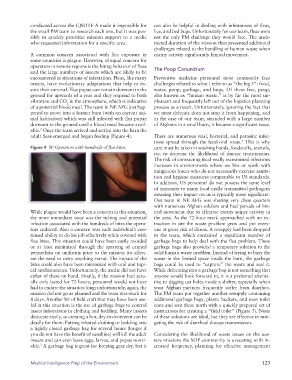
              adult fleas emerged and began feeding (Figure 4).  There are numerous viral, bacterial, and parasitic infec-
                                                                 tions spread through the fecal-oral route.  This is why
                                                                                                     4
              Figure 4  SF Operators with hundreds of flea bites.  care must be taken in washing hands, foodstuffs, utensils,
                                                                 etc. to decrease the likelihood of disease transmission.
                                                                 The risk of contracting fecal-orally transmitted infections
                                                                 increases  in  environments  where  we  live or  work with
                                                                 indigenous forces who do not necessarily exercise sanita-
                                                                 tion and hygiene measures comparable to US standards.
                                                                 In addition, US personnel do not possess the same level
                                                                 of immunity to many fecal-orally transmitted pathogens
                                                                 meaning their impact on us is typically more significant.
                                                                 Our team in NE AFG was sharing very close quarters
                                                                 with numerous Afghan soldiers and had periods of lim-
              While plague would have been a concern in this situation,   ited movement due to effective enemy sniper activity in
              the more immediate issue was the itching and potential   the area. As the 72-hour mark approached with no ex-
              infection associated with the hundreds of bites the opera-  traction in site the waste problem grew and put every-
              tors endured. Also a concern was each individual’s con-  one at great risk of illness. A resupply had been dropped
              tinued ability to do his job effectively while covered with   to the team, which contained a significant number of
              flea bites. This situation could have been easily avoided   garbage bags to help deal with the flea problem. These
              or at least minimized through the spraying of canned   garbage bags also provided a temporary solution to the
              permethrin on uniforms prior to the mission (to allevi-  solid human waste problem. Instead of trying to bury the
              ate the need to carry anything extra). The impact of the   waste in the limited space inside the barn, the garbage
              bites could also have been minimized with oral and topi-  bags could be used to “capture” the waste and seal it.
              cal antihistamines. Unfortunately, the medic did not have   While defecating into a garbage bag is not something that
              either of these on hand. Finally, if the mission had actu-  anyone would look forward to, it is a preferred alterna-
              ally only lasted for 72 hours, personnel would not have   tive to digging cat holes inside a shelter, especially when
              had to endure the situation long;  unfortunately, again, the   your Afghan partners frequently suffer from diarrhea.
              mission did not go as planned and the team was stuck for   The PM team put together another resupply containing
              8 days. Another bit of field craft that may have been use-  additional garbage bags, plastic buckets, and even toilet
              ful in this situation is the use of garbage bags to control   seats and sent these north with a quickly prepared set of
              insect infestations in clothing and bedding. Many insects   instructions for creating a “field toilet” (Figure 5). None
              desiccate easily, so creating a hot, dry environment can be   of these solutions are ideal, but they are effective in miti-
              deadly for them. Putting infested clothing or bedding into   gating the risk of diarrheal disease transmission.
              a tightly closed garbage bag for several hours (longer if
              you do not have the benefit of sunshine) will kill the adult   Considering the likelihood of waste issues on the aus-
              insects and can even leave eggs, larvae, and pupae nonvi-  tere missions the SOF community is executing with in-
              able.  A garbage bag is great for keeping gear dry, but it   creased frequency, planning for effective  management
                  3


              Medical Intelligence Prep of the Environment                                                   123

