


Page 132 - Journal of Special Operations Medicine - Winter 2015
P. 132
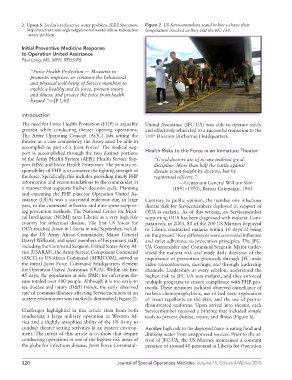
2.  Upson S. Jordan’s radioactive water problem. IEEE Spectrum.   Figure 2  US Servicemembers stand in line to have their
            http://spectrum.ieee.org/energy/environment/jordans-radioactive   temperature checked as they exit the KC-130.
            -water-problem.


          Initial Preventive Medicine Response
          to Operation United Assistance
          Paul Lang, MS, MPH, REHS/RS

              “Force Health Protection — Measures to
              promote, improve, or conserve the behavioral
              and physical well-being of Service members to
              enable a healthy and fit force, prevent injury
              and illness, and protect the force from health
              hazard.”—JP 1-02


          Introduction
          The need for Force Health Protection (FHP) is arguably   United Assistance (JFC-UA) was able to operate safely
          greatest while conducting theater opening operations.   and effectively which led to a successful transition to the
          The Army Operating Concept (AOC) lists setting the   101  Division (Airborne) Headquarters.
                                                                st
          theater as a core competency the Army must be able to
          accomplish as part of a Joint Force.  The medical sup-
                                          1
          port is accomplished through the two distinct portions   Health Risks to the Force in an Immature Theater
          of the Army Health System (AHS): Health Service Sup-   “Good doctors are of no use without good
          port (HSS) and Force Health Protection. The primary re-  discipline. More than half the battle against
          sponsibility of FHP is to conserve the fighting strength of   disease is not fought by doctors, but by
          the force. Specifically, this includes providing timely FHP   regimental officers.”
          information and recommendations to the commander in              —Lieutenant General William Slim
          a manner that supports his/her decision cycle. Planning       (1891–1970), Burma Campaign, 1943
          and executing the FHP plan for Operation United As-
          sistance (OUA) was a successful endeavor due, in large   Contrary to public opinion, the number one infectious
          part, to the command influence and time spent support-  disease risk for Servicemembers deployed in support of
          ing prevention methods. The National Center for Medi-  OUA is malaria. As of this writing, no Servicemember
          cal Intelligence (NCMI) rates Liberia as a very high risk   supporting OUA has been diagnosed with malaria. Com-
          country for infectious disease. The first US forces for   paratively, in 2003, 80 of the 200 US Marines deployed
          OUA touched down in Liberia in mid-September, includ-  to Liberia contracted malaria within 10 days of being
          ing the US  Army Africa Commander, Major General   on the ground.  Key differences were command influence
                                                                         2
          Darryl Williams, and select members of his primary staff,   and strict adherence to prevention principles. The JFC-
          including the Command Surgeon. United States Army Af-  UA Commander and Command Sergeant Major under-
          rica (USARAF), the Army Service Component Command   stood the malaria risk and made daily direction of the
          (ASCC) to US Africa Command (AFRICOM), served as   importance of prevention protocols through JFC wide
          the initial Joint Force Command headquarters element   video teleconferences, meetings, and through leadership
          for Operation United Assistance (OUA). Within the first   channels. Leadership, at every echelon, understood the
          45 days, the population at risk (PAR) for infectious dis-  highest risk to JFC-UA was malaria, and they enforced
          ease totaled over 500 people. Although it is too early to   multiple programs to ensure compliance with FHP pro-
          see disease and injury (D&I) trends, the early observed   tocols. These measures included observed compliance of
          rate of common illnesses affecting Servicemembers in an   malaria chemoprophylaxis, use of bed nets, application
          austere environment was markedly diminished (Figure 2).  of insect repellants on the skin, and the use of perme-
                                                             thrin-treated uniforms. Upon arrival into theater, each
          Challenges highlighted in this article stem from both   Servicemember received a briefing that  included simple
          conducting a large military operation in Western Af-  tools to prevent disease, injury, and illness (Figure 3).
          rica and a slightly atrophied ability of the US Army to
            conduct theater setting activities in an austere environ-  Another high risk to the deployed force is eating food and
          ment. The intent of this article is to show that despite   drinking water from unapproved sources. Prior to the ar-
          conducting operations in one of the highest risk areas of   rival of JFC-UA, the US Marines maintained a constant
          the globe for infectious disease, Joint Force Command–  presence of around 40 personnel in Liberia for Operation


          120                                    Journal of Special Operations Medicine  Volume 15, Edition 4/Winter 2015

