


Page 140 - Journal of Special Operations Medicine - Winter 2015
P. 140
probably best left to measurements that are more ob-  training for first responders, medics, and providers;
          jective. But, appearance and overall effectiveness of the   leader casualty response training; common simulations
          simulator should be mostly measured by the end user.  capability customized to service needs; evolutionary
                                                             development of simulations; development of best train-
          Medical simulation for our needs is currently woefully   ing methods, testing, and evaluation of TCCC devices;
          inadequate and immature. The logistical challenges be-  service specific Critical Task List sustainment training;
          hind fielding medical simulation and simulators have yet   shared service efforts; training the trainer courses for
          to be fully defined, communicated, and addressed. Cur-  simulation operators; and exportable simulation sup-
          rently, access to and procurement of medical simulators   port for medical simulation. This would be in line with
          depend mostly on individual units. This is an inadequate   recommendations from the Defense Health Board.
          solution as it leads to inadequate maintenance, account-
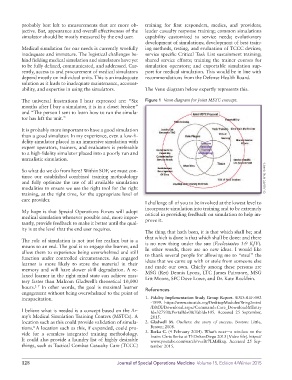
          ability, and expertise in using the simulators.    The Venn diagram below expertly represents this.

          The universal frustrations I hear expressed are: “Six   Figure 1  Venn diagram for Joint MSTC concept.
          months after I buy a simulator, it is in a closet broken”
          and “The person I sent to learn how to run the simula-
          tor has left the unit.”

          It is probably more important to have a good simulation
          than a good simulator. In my experience, even a low-fi-
          delity simulator placed in an immersive simulation with
          expert operators, trainers, and evaluators is preferable
          to a high-fidelity simulator placed into a poorly run and
          unrealistic simulation.

          So what do we do from here? Within SOF, we must con-
          tinue our established combined training methodology                                                  Courtesy LTC James Pairmore.
          and fully optimize the use of all available simulation
          modalities to ensure we use the right tool for the right
          training, at the right time, for the appropriate level of
          care provider.
                                                             I challenge all of you to be involved at the lowest level to
                                                             incorporate simulation into training and to be extremely
          My hope is that Special Operations Forces will adopt   critical in providing feedback on simulation to help im-
          medical simulation whenever possible and, more impor-  prove it.
          tantly, provide feedback to make it better until the qual-
          ity is at the level that the end user requires.
                                                             The thing that hath been, it is that which shall be; and
                                                             that which is done is that which shall be done: and there
          The role of simulation is not just for realism but is a   is no new thing under the sun (Ecclesiastes 1:9 KJV).
          means to an end. The goal is to engage the learner, and   In other words, there are no new ideas. I would like
          allow them to experience being overwhelmed and still   to thank several people for allowing me to “steal” the
          function under controlled circumstances. An engaged   ideas that we came up with or stole from someone else
          learner is more likely to store the material in their   and made our own. Chiefly among these persons are
          memory and will have slower skill degradation. A re-  MSG (Ret) Dennis Lyons, LTC James Pairmore, MSG
          laxed learner in the right mind state can achieve mas-  Litt Moore, SFC Dave Lowe, and Dr. Kate Rocklein.
          tery faster than Malcom Gladwell’s theoretical 10,000
          hours.  In other words, the goal is maximal learner   References
               2–7
          engagement without being overwhelmed to the point of
          incapacitation.                                    1.  Fidelity Implementation Study Group Report. SISO-REF-002
                                                               -1999. https://www.sisostds.org/DesktopModules/Bring2mind
                                                               /DMX/Download.aspx?Command=Core_Download&Entry
          I believe what is needed is a concept based on the Ar-  Id=32793&PortalId=0&TabId=105. Accessed 25 September,
          my’s Medical Simulation Training Centers (MSTCs). A   2015.
          location such as this could provide validation of simula-  2.  Gladwell M.  Outliers: the story of success. Boston: Little,
          tions. A location such as this, if expanded, could pro-  Brown; 2008.
               8
          vide for a seamless integrated training methodology.   3.  Berka C. (4 February 2014). What’s next—a window on the
                                                               brain: Chris Berka at TEDxSanDiego 2013 [Video file]. https://
          It could also provide a laundry list of highly desirable   www.youtube.com/watch?v=rBt7LMrIkxg. Accessed 25 Sep-
          things, such as Tactical Combat Casualty Care (TCCC)   tember 2015.


          128                                    Journal of Special Operations Medicine  Volume 15, Edition 4/Winter 2015

