


Page 116 - Journal of Special Operations Medicine - Winter 2015
P. 116
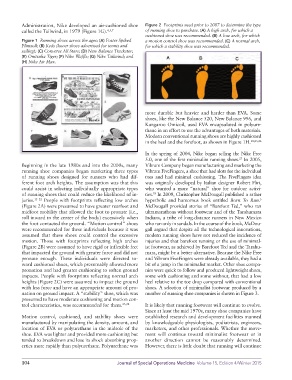
Administration, Nike developed an air-cushioned shoe   Figure 2  Footprints used prior to 2007 to determine the type
          called the Tailwind, in 1979 (Figure 1G). 4,5,7    of running shoe to purchase. (A) A high arch, for which a
                                                             cushioned shoe was recommended. (B) A low arch, for which
          Figure 1  Running shoes across the ages: (A) Foster Spiked   a motion control shoe was recommended. (C) A normal arch,
          Plimsoll; (B) Keds (lower shoes advertised for tennis and   for which a stability shoe was recommended.
          sailing); (C) Converse All Stars; (D) New Balance Trackster;
          (E) Onitsuka Tiger; (F) Nike Waffle; (G) Nike Tailwind; and
          (H) Nike Air Max.


                                                             more durable but heavier and harder than EVA. Some
                                                             shoes, like the New Balance 520, New Balance 996, and
                                                             Kangaroo Omicoil, used EVA encapsulated in polyure-
                                                             thane in an effort to use the advantages of both materials.
                                                             Modern conventional running shoes are highly cushioned
                                                             in the heel and the forefoot, as shown in Figure 1H. 18,25,26

                                                             In the spring of 2004, Nike began selling the Nike Free
                                                             5.0, one of the first minimalist running shoes.  In 2005,
                                                                                                    27
          Beginning in the late 1980s and into the 2000s, many   Vibram Company began manufacturing and marketing the
          running shoe companies began marketing three types   Vibram FiveFingers, a shoe that had slots for the individual
          of running shoes designed for runners who had dif-  toes  and  had  minimal  cushioning.  The  FiveFingers  idea
          ferent foot arch heights. The assumption was that this   was originally developed by Italian designer Robert Fliri,
          could assist in selecting individually appropriate types   who wanted a more “natural” shoe for outdoor activi-
          of running shoes that could reduce the likelihood of in-  ties.  In 2009, Christopher McDougall published a rather
                                                                28
          juries. 15–22  People with footprints reflecting low arches   hyperbolic and humorous book entitled  Born  To Run.
                                                                                                            3
          (Figure 2A) were presumed to have greater rearfoot and   McDougall provided stories of “Barefoot Ted,” who ran
          midfoot mobility that allowed the foot to pronate (i.e.,   ultramarathons without footwear and of the Tarahumara
          roll inward to the center of the body) excessively when   Indians, a tribe of long-distance runners in New Mexico
          the foot contacted the ground. “Motion control” shoes   who ran only in sandals. In the course of the book, McDou-
          were recommended for these individuals because it was   gall argued that despite all the technological innovations,
          assumed that these shoes could control the excessive   modern running shoes have not reduced the incidence of
          motion.  Those  with  footprints  reflecting  high  arches   injuries and that barefoot running or the use of minimal-
          (Figure 2B) were assumed to have rigid or inflexible feet   ist footwear, as achieved by Barefoot Ted and the Tarahu-
          that impacted the ground with greater force and did not   mara, might be a better alternative. Because the Nike Free
          pronate enough. These individuals were directed to-  and Vibram FiveFingers were already available, they had a
          ward cushioned shoes, which presumably allowed more   bit of a jump in the minimalist market. Other shoe compa-
          pronation and had greater cushioning to soften ground   nies were quick to follow and produced lightweight shoes,
          impacts. People with footprints reflecting normal arch   some with cushioning and some without, that had a low
          heights (Figure 2C) were assumed to impact the ground   heel relative to the toe drop compared with conventional
          with less force and have an appropriate amount of pro-  shoes. A selection of minimalist footwear produced by a
          nation on ground impact. A “stability” shoe, which was   number of running shoe companies is shown in Figure 3.
          presumed to have moderate cushioning and motion con-
          trol characteristics, was recommended for them. 23,24  It is likely that running footwear will continue to evolve.
                                                             Since at least the mid 1970s, many shoe companies have
          Motion control, cushioned, and stability shoes were   established research and development facilities manned
          manufactured by manipulating the density, amount, and   by knowledgeable physiologists, podiatrists, engineers,
          location of EVA or polyurethane in the midsole of the   marketers, and other professionals. Whether the move-
          shoe. EVA was lighter and provided more cushioning but   ment will continue toward minimalist footwear or in
          tended to breakdown and lose its shock absorbing prop-  another direction cannot be reasonably determined.
          erties more rapidly than polyurethane. Polyurethane was   However, there is little doubt that running will continue


          104                                    Journal of Special Operations Medicine  Volume 15, Edition 4/Winter 2015

