


Page 115 - Journal of Special Operations Medicine - Winter 2015
P. 115
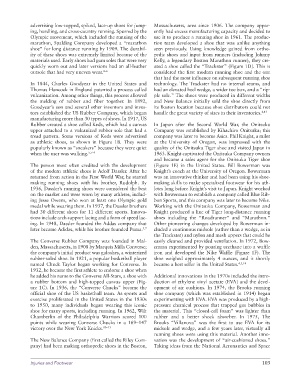
advertising low-topped, spiked, lace-up shoes for jump-  Massachusetts, area since 1906. The company appar-
              ing, hurdling, and cross-country running. Spurred by the   ently had excess manufacturing capacity and decided to
              Olympic movement, which included the running of the   use it to produce a running shoe in 1961. The produc-
              marathon, Spalding Company developed a “marathon   tion team developed a shoe that was unlike anything
              shoe” for long distance running by 1909. The durabil-  seen previously. Using knowledge gained from ortho-
              ity of these shoes was extremely limited because of the   pedic shoes and input from runners (including Johnny
              materials used. Early shoes had gum soles that were very   Kelly, a legendary Boston Marathon runner), they cre-
              quickly worn out and later versions had an all-leather   ated a shoe called the “Trackster” (Figure 1D). This is
              outsole that had very uneven wear. 4–6             considered the first modern running shoe and the one
                                                                 that had the most influence on subsequent running shoe
              In 1844, Charles Goodyear in the United States and   technology. The Trackster had no internal seams, and
              Thomas Hancock in England patented a process called   had an elevated heel wedge, a wider toe box, and a “rip-
              vulcanization. Among other things, this process allowed   ple sole.” The shoes were produced in different widths
              the melding of rubber and fiber together. In 1892,   and New Balance initially sold the shoe directly from
              Goodyear’s son and several other inventors and inves-  its Boston location because shoe distributors could not
              tors established the US Rubber Company, which began   handle the great variety of sizes in their inventories. 4,13
              manufacturing more than 30 types of shoes. In 1917, US
              Rubber created a shoe called Keds, which had a canvas   In Japan after the Second World War, the Onitsuka
              upper attached to a vulcanized rubber sole that had a   Company was established by Kihachiro Onitsuka; this
              tread pattern.  Some versions of Keds  were advertised   company was later to become Asics. Phil Knight, a miler
              as athletic shoes, as shown in Figure 1B. They were   at the University of Oregon, was impressed with the
              popularly known as “sneakers” because they were quiet   quality of the Onitsuka Tiger shoe and visited Japan in
              when the user was walking. 5,7–9                   1963. Knight captivated the Onitsuka Company owners
                                                                 and became a sales agent for the Onitsuka Tiger shoe
              The person most often credited with the development   (Figure 1E) in the United States. Bill Bowerman was
              of the modern athletic shoes is Adolf Dassler. After he   Knight’s coach at the University of Oregon. Bowerman
              returned from action in the First World War, he started   was an innovative thinker and had been using his shoe-
              making running shoes with his brother, Rudolph. By   making skills to make specialized footwear for his ath-
              1936, Dassler’s running shoes were considered the best   letes long before Knight’s visit to Japan. Knight worked
              on the market and were worn by many athletes, includ-  with Bowerman to establish a company called Blue Rib-
              ing Jesse Owens, who won at least one Olympic gold   bon Sports, and this company was later to become Nike.
              medal while wearing them. In 1937, the Dassler brothers   Working with the Onitsuka Company, Bowerman and
              had 30 different shoes for 11 different sports. Innova-  Knight produced a line of Tiger long-distance running
              tions include arch support lacing and a form of speed lac-  shoes including the “Roadrunner” and “Marathon.”
              ing. In 1948, Dassler founded the Addas company that   Other pioneering changes developed by Bowerman in-
              later became Adidas, while his brother founded Puma. 5,7  cluded a continuous midsole (rather than a wedge, as in
                                                                 the Trackster) and nylon and mesh uppers that could be
              The Converse Rubber Company was founded in Mal-    easily cleaned and provided ventilation. In 1972, Bow-
              den, Massachusetts, in 1908 by Marquis Mills Converse;   erman experimented by pouring urethane into a waffle
              the company’s initial product was galoshes, a winterized   iron and developed the Nike Waffle (Figure 1F). The
              rubber-soled shoe. In 1921, a popular basketball player   shoe weighed approximately 4 ounces, and it shortly
              named Chuck Taylor began working for Converse. In   became a best seller in the United States. 4,5,14
              1932, he became the first athlete to endorse a shoe when
              he added his name to the Converse All-Stars, a shoe with   Additional innovations in the 1970s included the intro-
              a rubber bottom  and high-topped canvas  upper (Fig-  duction of ethylene vinyl acetate (EVA) and the devel-
              ure 1C). In 1936, the “Converse Chucks” became the   opment of air cushions. In 1974, the Brooks running
              official shoe of the US basketball team. As sports and   shoe company (which was established in 1914) began
              exercise proliferated in the United States in the 1930s   experimenting with EVA. EVA was produced by a high-
              to 1950, many individuals began wearing this iconic   pressure chemical process that trapped gas bubbles in
              shoe for many sports, including running. In 1962, Wilt   the material. This “closed-cell foam” was lighter than
              Chamberlin  of  the  Philadelphia  Warriors  scored  100   rubber  and  a  better  shock  absorber.  In  1975,  The
              points while wearing Converse Chucks in a 169–147   Brooks “Villanova” was the first to use EVA for its
              victory over the New York Knicks. 10–13            midsole and wedge, and a few years later, virtually all
                                                                 running shoes were using this material. Another inno-
              The New Balance Company (first called the Riley Com-  vation was the development of “air-cushioned shoes.”
              pany) had been making orthopedic shoes in the Boston,   Taking ideas from the National Aeronautics and Space


              Injuries and Footwear                                                                          103

