


Page 108 - Journal of Special Operations Medicine - Fall 2014
P. 108
effective in facilitating stone passage.  Studies have also   stone, the patient can develop septic shock. This requires
                                          7
          shown that the rate of passage of stone may be improved   emergent surgical decompression of the obstruction. If
          somewhat by prescribing an α blocker or calcium chan-  a patient presents with acute pain and fever, then anti-
          nel blocker. Options include tamulosin 0.4mg once a day   biotic administration is appropriate. Reasonable initial
          or nifedipine for 7 to 14 days ; however, the use of these   choices include fluoroquinilones such as ciprofloxacin
                                   6
          medications may not be options in the deployed setting.  or levofloxacin. If those are unavailable, then ceftriax-
                                                             one or ertapenem would be reasonable choices.
          How rapidly do I need to evacuate?
                                                             What is the risk of recurrence?
          This patient does not require immediate evacuation. If
          the diagnosis is fairly certain, the patient is hemody-  The risk of recurrence is 60% for men and 40% for
          namically stable and afebrile, and pain control can be   women over 10 years. There is roughly a 10% to 15%
          achieved, there is no great urgency to evacuate. If the   risk of recurrence in the first year.  Some military per-
                                                                                           9
          patient is to be “sustained” in the field, then they must   sonnel may have avoided disclosing prior stones as it
          be adequately hydrated, pain adequately controlled, and   may affect their readiness status for deployment.
          vital signs observed for deterioration. It would be ap-
          propriate to begin charting vital signs, intake, and out-  Are there any preventive measures?
          put, as is done in a sustained-care setting.
                                                             Many experts recommend analysis of the stone to de-
                                                             termine its composition. Recommendations on diet and
          Patients with a history of existing renal disease, a soli-  hydration can be then made based on its composition.
          tary kidney, fever, symptoms of infection, or clinical de-  However, no preventative measure has been entirely
          terioration require emergent evacuation.
                                                             successful  in  completely  preventing  future  stones.  Ex-
                                                             pert consensus suggests increasing hydration to produce
          How likely are they to pass the stone?
                                                             2 L/day urine.  This aggressive regimen may be tough
                                                                         10
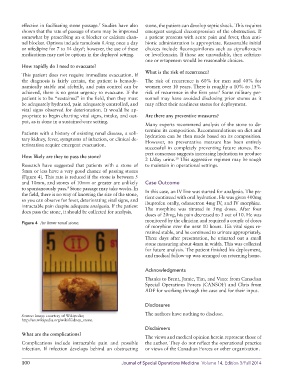
          Research have suggested that patients with a stone of   to maintain in operational settings.
          5mm or less have a very good chance of passing stones
          (Figure 4). This rate is reduced if the stone is between 5
          and 10mm, and stones of 10mm or greater are unlikely   Case Outcome
          to spontaneously pass.  Stone passage may take weeks. In   In this case, an IV line was started for analgesia. The pa-
                             8
          the field, there is no way of knowing the size of the stone,   tient continued with oral hydration. He was given 400mg
          so you can observe for fever, deteriorating vital signs, and   ibuprofen orally, odansetron 4mg IV, and IV morphine.
          intractable pain despite adequate analgesia. If the patient   The morphine  was  titrated in  5mg  doses. After  four
          does pass the stone, it should be collected for analysis.
                                                             doses of 20mg, his pain decreased to 3 out of 10. He was
                                                             monitored by the clinician and required a couple of doses
          Figure 4  An 8mm renal stone.
                                                             of morphine over the next 10 hours. His vital signs re-
                                                             mained stable, and he continued to urinate appropriately.
                                                             Three days after presentation, he urinated out a small
                                                             stone measuring about 4mm in width. This was collected
                                                             for future analysis. The patient finished his deployment,
                                                             and medical follow-up was arranged on returning home.


                                                             Acknowledgments
                                                             Thanks to Brent, Jamie, Tim, and Vince from Canadian
                                                             Special Operations Forces (CANSOF) and Chris from
                                                             ADF for working through the case and for their input.


                                                             Disclosures

          Source: Image courtesy of Wikipedia;               The authors have nothing to disclose.
          http://en.wikipedia.org/wiki/Kidney_stone.
                                                             Disclaimers
          What are the complications?
                                                             The views and medical opinion herein represent those of
          Complications include intractable pain and possible   the author. They do not reflect the operational practice
          infection. If infection develops behind an obstructing   or views of the Canadian Forces or other organization.


          100                                      Journal of Special Operations Medicine  Volume 14, Edition 3/Fall 2014

