


Page 112 - Journal of Special Operations Medicine - Fall 2014
P. 112
incomplete data were excluded. Analysis was performed   Figure 3  Patient chief complaints.
          on the  254 charts  that met  inclusion criteria  for the
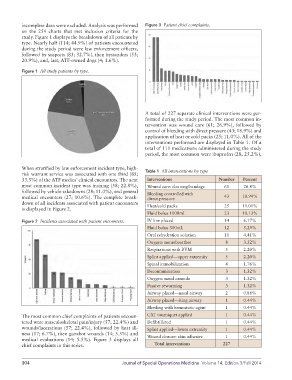
          study. Figure 1 displays the breakdown of all patients by
          type. Nearly half (114; 44.9%) of patients encountered
          during the study period were law enforcement officers,
          followed by suspects (83; 32.7%), then bystanders (53;
          20.9%), and, last, ATF-owned dogs (4; 1.6%).

          Figure 1  All study patients by type.


                                                             A total of 227 separate clinical interventions were per-
                                                             formed during the study period. The most common in-
                                                             tervention was wound care (61; 26.9%), followed by
                                                             control of bleeding with direct pressure (43; 18.9%) and
                                                             application of heat or cold packs (25; 11.0%). All of the
                                                             interventions performed are displayed in Table 1. Of a
                                                             total of 111 medications administered during the study
                                                             period, the most common were ibuprofen (28; 25.2%),

          When stratified by law enforcement incident type, high-  Table 1  All interventions by type
          risk warrant service was associated with one third (85;
          33.5%) of the ATF medics’ clinical encounters. The next   Interventions          Number    Percent
          most common incident type was training (58; 22.8%),   Wound care: cleaning/bandage  61      26.8%
          followed by vehicle takedowns (28; 11.0%), and general   Bleeding controlled with
          medical encounters (27; 10.6%). The complete break-  direct pressure                43     18.94%
          down of all incidents associated with patient encounters   Heat/cold packs          25     11.01%
          is displayed in Figure 2.
                                                              Fluid bolus 1000mL              23     10.13%
          Figure 2  Incidents associated with patient encounters.  IV line placed             14      6.17%
                                                              Fluid bolus 500mL               12      5.29%
                                                              Oral rehydration solution       10      4.41%
                                                              Oxygen: nonrebreather           8       3.52%
                                                              Respirations with BVM           5       2.20%
                                                              Splint applied—upper extremity  5       2.20%
                                                              Spinal immobilization           4       1.76%
                                                              Decontamination                 3       1.32%
                                                              Oxygen: nasal cannula           3       1.32%
                                                              Passive rewarming               3       1.32%
                                                              Airway placed—nasal airway      2       0.88%
                                                              Airway placed—King airway       1       0.44%
                                                              Bleeding with hemostatic agent  1       0.44%

          The most common chief complaints of patients encoun-  CAT tourniquet applied        1       0.44%
          tered were musculoskeletal pain/injury (57; 22.4%) and   Defibrillated              1       0.44%
          wounds/lacerations (57; 22.4%), followed by heat ill-  Splint applied—lower extremity  1    0.44%
          ness (17; 6.7%), then gunshot wounds (14; 5.5%) and   Wound closure: skin adhesive  1       0.44%
          medical  evaluations  (14;  5.5%).  Figure  3  displays  all
          chief complaints in this series.                          Total interventions      227


          104                                      Journal of Special Operations Medicine  Volume 14, Edition 3/Fall 2014

