


Page 104 - Journal of Special Operations Medicine - Fall 2014
P. 104
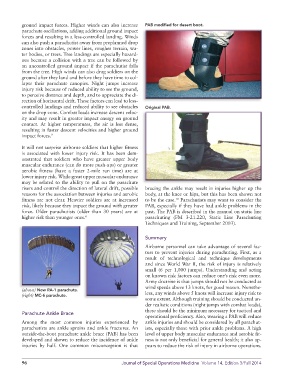
ground impact forces. Higher winds can also increase   PAB modified for desert boot.
          parachute oscillations, adding additional ground impact
          forces and resulting in a less-controlled landing. Winds
          can also push a parachutist away from preplanned drop
          zones into obstacles, power lines, rougher terrain, wa-
          ter bodies, or trees. Tree landings are especially hazard-
          ous because a collision with a tree can be followed by
          an uncontrolled ground impact if the parachutist falls
          from the tree. High winds can also drag soldiers on the
          ground after they land and before they have time to col-
          lapse their parachute canopies. Night jumps increase
          injury risk because of reduced ability to see the ground,
          to perceive distance and depth, and to appreciate the di-
          rection of horizontal drift. These factors can lead to less-
          controlled landings and reduced ability to see obstacles   Original PAB.
          on the drop zone. Combat loads increase descent veloc-
          ity and may result in greater impact energy on ground
          contact. At higher temperatures, the air is less dense,
          resulting in faster descent velocities and higher ground
          impact forces. 9

          It will not surprise airborne soldiers that higher fitness
          is associated with lower injury risk. It has been dem-
          onstrated that soldiers  who have greater upper  body
          muscular endurance (can do more push-ups) or greater
          aerobic fitness (have a faster 2-mile run time) are at
          lower injury risk. While great upper muscular endurance
          may be related to the ability to pull on the parachute
          risers and control the direction of lateral drift, possible   bracing the ankle may result in injuries higher up the
          reasons for the association between injuries and aerobic   body, at the knee or hips, but this has been shown not
                                                                          10
          fitness  are  not  clear.  Heavier  soldiers  are  at increased   to be the case.  Parachutists may want to consider the
          risk, likely because they impact the ground with greater   PAB, especially if they have had ankle problems in the
          force. Older parachutists (older than 30 years) are at   past. The PAB is described in the manual on static line
          higher risk than younger ones. 6                   parachuting (FM 3-21.220, Static Line Parachuting
                                                             Techniques and Training, September 2003).


                                                             Summary
                                                             Airborne personnel can take advantage of several fac-
                                                             tors to prevent injuries during parachuting. First, as a
                                                             result  of  technological  and  technique  developments
                                                             and since World War II, the risk of injury is relatively
                                                             small (6 per 1,000 jumps). Understanding and acting
                                                             on known risk factors can reduce one’s risk even more.
                                                             Army doctrine is that jumps should not be conducted at
                                                             wind speeds above 13 knots, for good reason. Nonethe-
          (above) New RA-1 parachute.                        less, any winds above 5 knots will increase injury risk to
          (right) MC-6 parachute.
                                                             some extent. Although training should be conducted un-
                                                             der realistic conditions (night jumps with combat loads),
                                                             these should be the minimum necessary for tactical and
          Parachute Ankle Brace
                                                             operational proficiency. Also, wearing a PAB will reduce
          Among  the  most  common  injuries  experienced  by   ankle injuries and should be considered by all parachut-
          parachutists are ankle sprains and ankle fractures. An   ists, especially those with prior ankle problems. A high
          outside-the-boot parachute ankle brace (PAB) has been   level of upper body muscular endurance and aerobic fit-
          developed and shown to reduce the incidence of ankle   ness is not only beneficial for general health; it also ap-
          injuries by half. One common misconception is that   pears to reduce the risk of injury in airborne operations.


          96                                       Journal of Special Operations Medicine  Volume 14, Edition 3/Fall 2014

