


Page 54 - ATP-P 11th Ed
P. 54
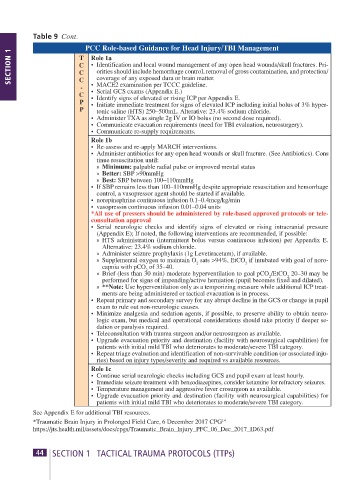
Table 9  Cont.
                    PCC Role-based Guidance for Head Injury/TBI Management
   SECTION 1      T  Role 1a
                  C  •  Identification and local wound management of any open head wounds/skull fractures. Pri-
                      orities should include hemorrhage control, removal of gross contamination, and protection/
                  C
                      coverage of any exposed dura or brain matter.
                  C
                   -   •  MACE2 examination per TCCC guideline.
                  C   •  Serial GCS exams (Appendix E.)
                     •  Identify signs of elevated or rising ICP per Appendix E.
                  P   •  Initiate immediate treatment for signs of elevated ICP including initial bolus of 3% hyper-
                  P   tonic saline (HTS) 250–500mL. Alterative: 23.4% sodium chloride.
                     •  Administer TXA as single 2g IV or IO bolus (no second dose required).
                     •  Communicate evacuation requirements (need for TBI evaluation, neurosurgery).
                     •  Communicate re-supply requirements.
                     Role 1b
                     •  Re-assess and re-apply MARCH interventions.
                     •  Administer antibiotics for any open head wounds or skull fracture. (See Antibiotics). Cons -
                      tinue resuscitation until:
                         » Minimum: palpable radial pulse or improved mental status
                         » Better: SBP >90mmHg
                         » Best: SBP between 100–110mmHg
                     •  If SBP remains less than 100–110mmHg despite appropriate resuscitation and hemorrhage
                      control, a vasopressor agent should be started if available.
                     •  norepinephrine continuous infusion 0.1–0.4mcg/kg/min
                     •  vasopressin continuous infusion 0.01–0.04 units
                     *All use of pressers should be administered by role-based approved protocols or tele-
                     con sul tation approval
                     •  Serial  neurologic  checks  and  identify  signs  of  elevated  or  rising  intracranial  pressure
                      ( Appendix E); If noted, the following interventions are recommended, if possible:
                         » HTS  administration (intermittent  bolus  versus  continuous infusion)  per Appendix  E.
                         Alternative: 23.4% sodium chloride.
                         » Administer seizure prophylaxis (1g Levetiracetam), if available.
                         » Supplemental oxygen to maintain O  sats >94%, EtCO  if intubated with goal of noro-
                       capnia with pCO  of 35–40.  2  2
                                 2
                         » Brief (less than 30 min) moderate hyperventilation to goal pCO /EtCO  20–30 may be
                                                            2
                                                                2
                       performed for signs of impending/active herniation (pupil becomes fixed and dilated).
                         » **Note: Use hyperventilation only as a temporizing measure while additional ICP treat-
                       ments are being administered or tactical evacuation is in process.
                     •  Repeat primary and secondary survey for any abrupt decline in the GCS or change in pupil
                      exam to rule out non-neurologic causes.
                     •  Minimize analgesia and sedation agents, if possible, to preserve ability to obtain neuro-
                      logic exam, but medical and operational considerations should take priority if deeper se-
                      dation or paralysis required.
                     •  Teleconsultation with trauma surgeon and/or neurosurgeon as available.
                     •  Upgrade evacuation priority and destination (facility with neurosurgical capabilities) for
                      patients with initial mild TBI who deteriorates to moderate/severe TBI category.
                     •  Repeat triage evaluation and identification of non-survivable condition (or associated inju-
                      ries) based on injury types/severity and required vs available resources.
                     Role 1c
                     •  Continue serial neurologic checks including GCS and pupil exam at least hourly.
                     •  Immediate seizure treatment with benzodiazepines, consider ketamine for refractory seizures.
                     •  Temperature management and aggressive fever crosurgeon as available.
                     •  Upgrade evacuation priority and destination (facility with neurosurgical capabilities) for
                      patients with initial mild TBI who deteriorates to moderate/severe TBI category.
        See Appendix E for additional TBI resources.
        *Traumatic Brain Injury in Prolonged Field Care, 6 December 2017 CPG 14
        https://jts.health.mil/assets/docs/cpgs/Traumatic_Brain_Injury_PFC_06_Dec_2017_ID63.pdf
          44  SECTION 1   TACTICAL TRAUMA PROTOCOLS (TTPs)                                                                    ATP-P Handbook 11th Edition  45

