


Page 52 - ATP-P 11th Ed
P. 52
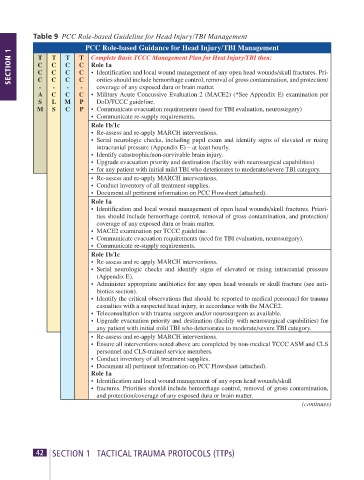
Table 9  PCC Role-based Guideline for Head Injury/TBI Management
                    PCC Role-based Guidance for Head Injury/TBI Management
   SECTION 1  T   T   T    T  Complete Basic TCCC Management Plan for Heat Injury/TBI then:
            C
         C
               C   C  Role 1a
            C
         C
               C   C  •  Identification and local wound management of any open head wounds/skull fractures. Pri-
         C
          -   C -   C -   C -   orities should include hemorrhage control, removal of gross contamination, and protection/
                      coverage of any exposed dura or brain matter.
         A   C   C   C  •  Military Acute Concussive Evaluation 2 (MACE2) (*See Appendix E) examination per
         S   L   M   P   DoD/TCCC guideline.
         M  S  C  P  •  Communicate evacuation requirements (need for TBI evaluation, neurosurgery)
                     •  Communicate re-supply requirements.
                     Role 1b/1c
                     •  Re-assess and re-apply MARCH interventions.
                     •  Serial neurologic checks, including pupil exam and identify signs of elevated or rising
                      intracranial pressure (Appendix E) – at least hourly.
                     •  Identify catastrophic/non-survivable brain injury.
                     •  Upgrade evacuation priority and destination (facility with neurosurgical capabilities)
                     •  for any patient with initial mild TBI who deteriorates to moderate/severe TBI category.
                     •  Re-assess and re-apply MARCH interventions.
                     •  Conduct inventory of all treatment supplies.
                     •  Document all pertinent information on PCC Flowsheet (attached).
                     Role 1a
                     •  Identification and local wound management of open head wounds/skull fractures. Priori-
                      ties should include hemorrhage control, removal of gross contamination, and protection/
                      coverage of any exposed dura or brain matter.
                     •  MACE2 examination per TCCC guideline.
                     •  Communicate evacuation requirements (need for TBI evaluation, neurosurgery).
                     •  Communicate re-supply requirements.
                     Role 1b/1c
                     •  Re-assess and re-apply MARCH interventions.
                     •  Serial  neurologic  checks  and  identify  signs  of  elevated  or  rising  intracranial  pressure
                      ( Appendix E).
                     •  Administer appropriate antibiotics for any open head wounds or skull fracture (see anti-
                      biotics section).
                     •  Identify the critical observations that should be reported to medical personnel for trauma
                      casualties with a suspected head injury, in accordance with the MACE2.
                     •  Teleconsultation with trauma surgeon and/or neurosurgeon as available.
                     •  Upgrade evacuation priority and destination (facility with neurosurgical capabilities) for
                      any patient with initial mild TBI who deteriorates to moderate/severe TBI category.
                     •  Re-assess and re-apply MARCH interventions.
                     •  Ensure all interventions noted above are completed by non-medical TCCC ASM and CLS
                      personnel and CLS-trained service members.
                     •  Conduct inventory of all treatment supplies.
                     •  Document all pertinent information on PCC Flowsheet (attached).
                     Role 1a
                     •  Identification and local wound management of any open head wounds/skull
                     •  fractures. Priorities should include hemorrhage control, removal of gross contamination,
                      and protection/coverage of any exposed dura or brain matter.
                                                                   (continues)

          42  SECTION 1   TACTICAL TRAUMA PROTOCOLS (TTPs)                                                                    ATP-P Handbook 11th Edition  43

