


Page 51 - ATP-P 11th Ed
P. 51
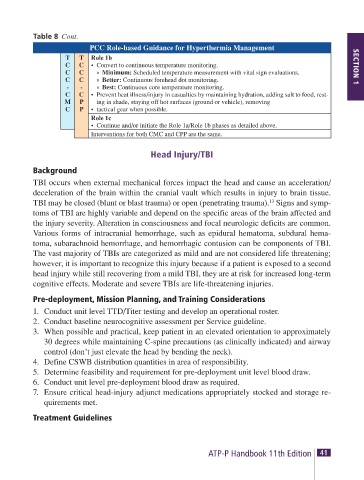
Table 8  Cont.
                     PCC Role-based Guidance for Hyperthermia Management
               T    T  Role 1b
               C   C  •  Convert to continuous temperature monitoring.        SECTION 1
               C   C     » Minimum: Scheduled temperature measurement with vital sign evaluations.
               C  C      » Better: Continuous forehead dot monitoring.
                -   -     » Best: Continuous core temperature monitoring.
               C   C  •  Prevent heat illness/injury in casualties by maintaining hydration, adding salt to food, rest-
               M   P   ing in shade, staying off hot surfaces (ground or vehicle), removing
               C  P  •  tactical gear when possible.
                     Role 1c
                     •  Continue and/or initiate the Role 1a/Role 1b phases as detailed above.
                     Interventions for both CMC and CPP are the same.
                                  Head Injury/TBI
        Background
        TBI occurs when external mechanical forces impact the head and cause an acceleration/
        deceleration of the brain within the cranial vault which results in injury to brain tissue.
        TBI may be closed (blunt or blast trauma) or open (penetrating trauma).  Signs and symp-
                                                            13
        toms of TBI are highly variable and depend on the specific areas of the brain affected and
        the injury severity. Alteration in consciousness and focal neurologic deficits are common.
        Various forms of intracranial hemorrhage, such as epidural hematoma, subdural hema-
        toma, subarachnoid hemorrhage, and hemorrhagic contusion can be components of TBI.
        The vast majority of TBIs are categorized as mild and are not considered life threatening;
        however, it is important to recognize this injury because if a patient is exposed to a second
        head injury while still recovering from a mild TBI, they are at risk for increased long-term
        cognitive effects. Moderate and severe TBIs are life-threatening injuries.
        Pre-deployment, Mission Planning, and Training Considerations
        1.  Conduct unit level TTD/Titer testing and develop an operational roster.
        2.  Conduct baseline neurocognitive assessment per Service guideline.
        3.  When possible and practical, keep patient in an elevated orientation to approximately
           30 degrees while maintaining C-spine precautions (as clinically indicated) and airway
           control (don’t just elevate the head by bending the neck).
        4.  Define CSWB distribution quantities in area of responsibility.
        5.  Determine feasibility and requirement for pre-deployment unit level blood draw.
        6.  Conduct unit level pre-deployment blood draw as required.
        7.  Ensure critical head-injury adjunct medications appropriately stocked and storage re-
           quirements met.
        Treatment Guidelines


   40  SECTION 1   TACTICAL TRAUMA PROTOCOLS (TTPs)     ATP-P Handbook 11th Edition  41

