


Page 48 - ATP-P 11th Ed
P. 48
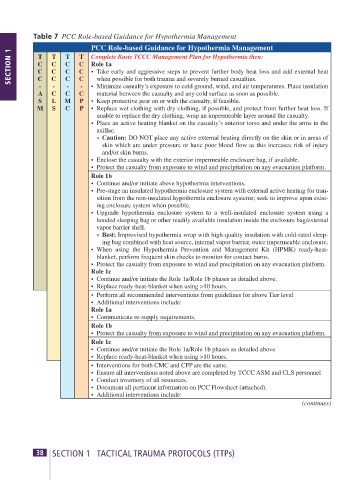
Table 7  PCC Role-based Guidance for Hypothermia Management
                     PCC Role-based Guidance for Hypothermia Management
   SECTION 1  C   C   C   C  Role 1a
               T
         T
            T
                  T  Complete Basic TCCC Management Plan for Hypothermia then:
            C
         C
               C   C  •  Take early and aggressive steps to prevent further body heat loss and add external heat
         C
                      when possible for both trauma and severely burned casualties.
          -   C -   C -   C -   •  Minimize casualty’s exposure to cold ground, wind, and air temperatures. Place insulation
         A   C   C   C   material between the casualty and any cold surface as soon as possible.
         S   L   M   P  •  Keep protective gear on or with the casualty, if feasible.
         M  S  C  P  •  Replace wet clothing with dry clothing, if possible, and protect from further heat loss. If
                      unable to replace the dry clothing, wrap an impermeable layer around the casualty.
                     •  Place an active heating blanket on the casualty’s anterior torso and under the arms in the
                      axillae.
                         » Caution: DO NOT place any active external heating directly on the skin or in areas of
                       skin which are under pressure or have poor blood flow as this increases risk of injury
                       and/or skin burns.
                     •  Enclose the casualty with the exterior impermeable enclosure bag, if available.
                     •  Protect the casualty from exposure to wind and precipitation on any evacuation platform.
                     Role 1b
                     •  Continue and/or initiate above hypothermia interventions.
                     •  Pre-stage an insulated hypothermia enclosure system with external active heating for tran-
                      sition from the non-insulated hypothermia enclosure systems; seek to improve upon exist-
                      ing enclosure system when possible.
                     •  Upgrade hypothermia enclosure system to a well-insulated enclosure system using a
                      hooded sleeping bag or other readily available insulation inside the enclosure bag/external
                      vapor barrier shell.
                         » Best: Improvised hypothermia wrap with high-quality insulation with cold-rated sleep-
                       ing bag combined with heat source, internal vapor barrier, outer impermeable enclosure.
                     •  When using the Hypothermia Prevention and Management Kit (HPMK) ready-heat-
                      blanket, perform frequent skin checks to monitor for contact burns.
                     •  Protect the casualty from exposure to wind and precipitation on any evacuation platform.
                     Role 1c
                     •  Continue and/or initiate the Role 1a/Role 1b phases as detailed above.
                     •  Replace ready-heat-blanket when using >10 hours.
                     •  Perform all recommended interventions from guidelines for above Tier level
                     •  Additional interventions include:
                     Role 1a
                     •  Communicate re-supply requirements.
                     Role 1b
                     •  Protect the casualty from exposure to wind and precipitation on any evacuation platform.
                     Role 1c
                     •  Continue and/or initiate the Role 1a/Role 1b phases as detailed above
                     •  Replace ready-heat-blanket when using >10 hours.
                     •  Interventions for both CMC and CPP are the same.
                     •  Ensure all interventions noted above are completed by TCCC ASM and CLS personnel
                     •  Conduct inventory of all resources.
                     •  Document all pertinent information on PCC Flowsheet (attached).
                     •  Additional interventions include:
                                                                   (continues)
          38  SECTION 1   TACTICAL TRAUMA PROTOCOLS (TTPs)                                                                    ATP-P Handbook 11th Edition  39

